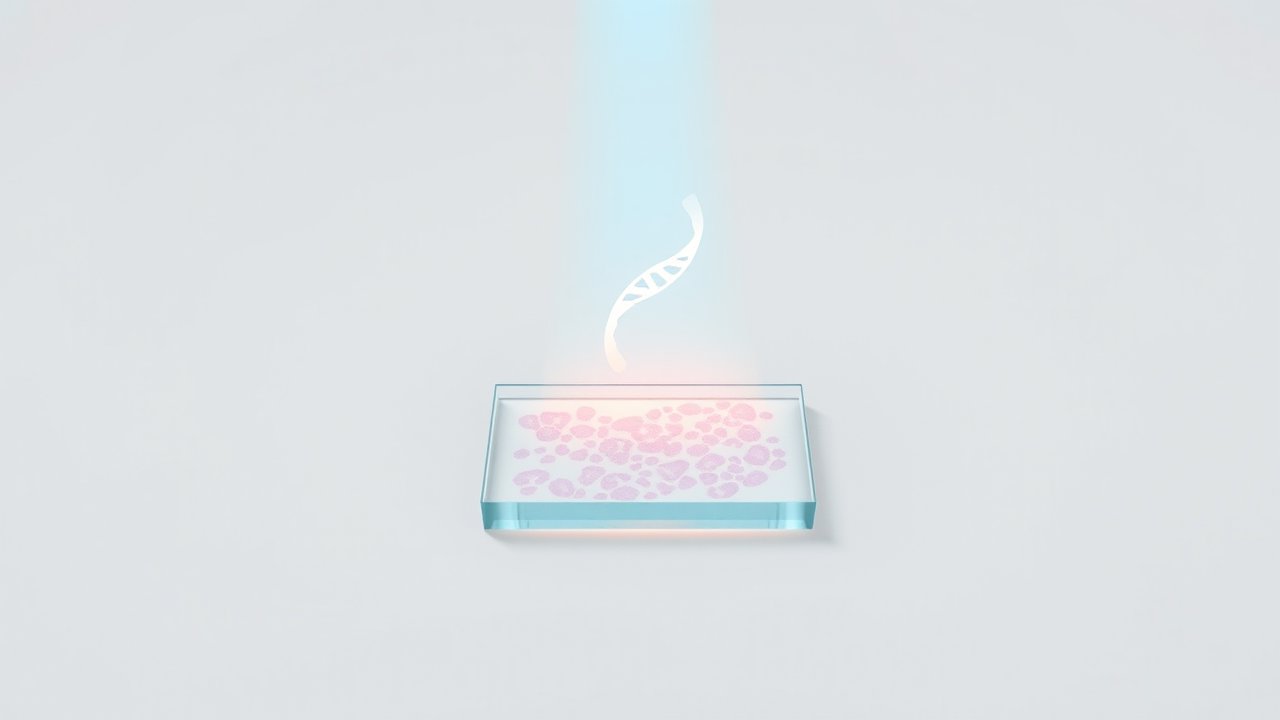
Researchers at Sanford Burnham Prebys Medical Discovery Institute have created a computational breakthrough that reads the body's aging clock from ordinary tissue samples. Their AI model, called TLPath, can predict telomere length by examining the structural changes in cells captured in standard biopsy slides.
Telomeres are protective DNA caps at the ends of chromosomes that naturally shorten each time cells divide. Scientists have long known these genetic buffers correlate with both chronological age and disease risk, but measuring them directly requires expensive, specialized laboratory tests. TLPath offers a workaround by spotting the architectural fingerprints that telomere shortening leaves in tissue structure.
The team trained their model on a massive dataset from the NIH's Genotype-Tissue Expression Project—over 5,000 high-resolution slides from 919 people across 18 different organs. The AI breaks each slide into roughly 1,400 fragments and identifies up to 1,024 structural features per fragment, learning which patterns predict telomere length. According to findings published in Cell Reports Methods, TLPath outperformed simple age-based predictions and could even distinguish telomere differences between people of identical ages.
"The only limit to using an approach such as TLPath is the availability of scanned histopathology slides," said Dr. Sanju Sinha, the assistant professor who led the research. The catch is that while hospitals routinely create these slides for diagnosis, they're rarely digitized and archived for research purposes.
If medical institutions begin systematically scanning and storing biopsy slides, Sinha believes it could "transform our ability to study telomere biology, learn more about human aging and ultimately help people preserve better health as they age." The tool essentially turns every routine biopsy into a potential window on biological aging—no additional testing required.