Search tips — use boolean operators for precise results
  • "exact phrase" — match exact words in order
  • maxwell AND clinton — both terms required
  • epstein OR maxwell — either term
  • epstein -trump — exclude a term
  • (maxwell OR clinton) AND "flight logs" — group terms

Found 16+ results for "gain of function"

breitbart.com News 8/10 ?

Exclusive – Sen. Ron Johnson Seeks ‘Covid Reckoning’: ‘I Want to Make Sure That Anthony Fauci’s Reputation Is Completely Destroyed’

…Johnson accused Fauci of helping fund gain-of-function research that may have contributed to the pandemic and then covering up the origins of COVID-19.…

…He also criticized Fauci’s role in promoting the COVID vaccines, which he called a “deadly injection”: What he did — funding gain-of-function research — probably contributed to the pandemic.…

Show full text (2664 chars)
Sen. Ron Johnson (R-WI) called for a “COVID reckoning,” saying officials involved in the government’s pandemic response must be exposed and held accountable. “I think it’s crucial that we have a COVID reckoning,” Johnson said during the Fight Club Roundtable hosted by Breitbart News Editor-in-Chief Alex Marlow and Washington Bureau Chief Matthew Boyle. “These people need to be held accountable.” Johnson said public exposure may be the most significant form of accountability because criminal prosecutions would be difficult. He accused officials of avoiding written records and destroying emails that could have documented their actions. “They didn’t leave much of a trail,” Johnson said. “They learned how to destroy emails. They didn’t memorialize things in emails. They’re not that stupid. So it’s going to be difficult.” Johnson said his staff is reviewing roughly one million pages of material and continues to uncover information from new devices. He said investigators are organizing the records rather than releasing them all at once. “We keep finding more things, trying to reveal that and expose it in an organized fashion so it actually makes sense to people rather than just dumping it on the public,” he said. Johnson added that investigators must withhold some documents while interviewing witnesses so those involved do not know what evidence the committee has obtained. “That’s not a way to conduct a serious investigation,” Johnson said of releasing every document immediately. The Wisconsin Republican then turned his attention to former National Institute of Allergy and Infectious Diseases Director Dr. Anthony Fauci. “I want to make sure that Anthony Fauci’s reputation is completely destroyed, that people actually understand what a truly monstrous individual he was,” Johnson said. Johnson accused Fauci of helping fund gain-of-function research that may have contributed to the pandemic and then covering up the origins of COVID-19. He also criticized Fauci’s role in promoting the COVID vaccines, which he called a “deadly injection”: What he did — funding gain-of-function research — probably contributed to the pandemic. Then he covered it all up and pushed a deadly injection on the global population. Nobody knows how destructive that injection will be in the long term. This is a bad guy. I think his appearance before the Homeland Security Committee was a very bad day for him. “He is being held accountable through the destruction of his ‘Saint Fauci’ reputation, even though Democrats and the media still want to put him on that pedestal. But I think more Americans’ eyes are open to what a monster he truly was,” said Johnson.
Gateway Pundit News 8/10 ?

REPORT: Fauci Told Aide to Permanently Delete Emails About Gain-of-Function Research

…Anthony Fauci instructed an aide to permanently delete an email concerning controversial gain-of-function research years before the COVID-19 pandemic.The emails, obtained by the Daily Caller News Foundation…

…email to an aide about that warning, then instructed the…pic.twitter.com/QdsWusepAT— Daily Caller (@DailyCaller)August 28, 2026The experiments triggered debate over whether the potential benefits of gain-of-function

Show full text (4206 chars)
Newly obtained documents reportedly show that Dr. Anthony Fauci instructed an aide to permanently delete an email concerning controversial gain-of-function research years before the COVID-19 pandemic.The emails, obtained by the Daily Caller News Foundation, date back to 2012, when Fauci was defending experiments that made a highly dangerous strain of bird flu transmissible through the air.Dutch virologist Ron Fouchier conducted the experiments with funding from Fauci’s National Institute of Allergy and Infectious Diseases (NIAID).Fouchier described the resulting virus as “probably one of the most dangerous viruses you can make.”Eight years before COVID emerged, a journalist issued a prophetic warning that risky viral research could usher in “doomsday” and damage the reputation of the National Institutes of Health (NIH). Anthony Fauci groused in an email to an aide about that warning, then instructed the…pic.twitter.com/QdsWusepAT— Daily Caller (@DailyCaller)August 28, 2026The experiments triggered debate over whether the potential benefits of gain-of-function research justified the potentially catastrophic consequences of an accidental laboratory escape.New York Times science writer Phil Boffey was among those sounding the alarm, warning of an “engineered doomsday” capable of killing “hundreds of millions of people.”Boffey also suggested that the NIH had its own reputation at stake because it had financed the experiments.That criticism apparently irritated Fauci.“Phil Boffey is really off base here,” Fauci wrote to then-NIH Director Francis Collins on March 4, 2012. “He is acting like a mischievous guy.”The following morning, Fauci complained about the article to his subordinate.“Clearly, people are getting to Phil Boffey and he is swallowing it,” he wrote.Fauci then gave an explicit instruction concerning the correspondence.“Please delete this e-mail and then delete from the deleted file,” Fauci wrote from his government email account.The revelation raises further questions about Fauci’s handling of federal records.Sen. Rand Paul (R-KY) has previously highlighted two other instances in which Fauci allegedly sought to delete government communications.Fauci testified before Congress in 2024 that he had not destroyed official records.The latest disclosure comes after separate documents revealed NIAID’s cooperation with the CIA on sensitive virus and biological-threat research during Fauci’s tenure.New Documents Confirm Fauci’s NIAID Provided Cover for CIA Bioterrorism Research — CIA Helped Obtain the Viruses and Controlled What Data Could Be Shared&&&&&&&&&&&Those records showed an interagency arrangement under which the CIA’s Biological Technology Center worked with NIAID on “forensic microbiology.”This included provisions allowing the CIA to assist in obtaining biological agents and restricting NIAID from releasing certain research data without CIA approval.Fauci ultimately succeeded in pushing for Fouchier’s controversial bird-flu research to be published in full.Fouchier would later participate in private discussions with Fauci and other scientists about the origins of COVID-19 and contributed arguments to the influential “Proximal Origin” paper, which argued against a laboratory origin being likely.The Gateway Pundit has long reported on the numerous controversies and alleged misconduct surrounding America’s most influential health official and the pressure on the former NIAID director now appears to be mounting.Several weeks ago, Fauci’s former senior adviser, David Morens,pleaded guiltyto conspiring to defraud the United States by concealing information about the origins of COVID-19 and attempting to evade Freedom of Information Act (FOIA) requests.After an FBI investigation with our DOJ partners, Dr. Fauci’s associate, David Morens, just pleaded guilty to conspiracy in a scheme to avoid FOIA requests and the Federal Records Act connected to COVID-19 research grants.The FBI uncovered that Morens, Co-Conspirator 1,…pic.twitter.com/IR7TCUm10m— FBI Director Kash Patel (@FBIDirectorKash)August 18, 2026The postREPORT: Fauci Told Aide to Permanently Delete Emails About Gain-of-Function Researchappeared first onThe Gateway Pundit.
Investing.com Markets 7/10 ?

Bitcoin steadies below $78k with U.S. regulatory developments in focus

…It had risen as high as $82,000 in late-August before tempering some gains.…

…Bets on a Bank of Japan rate hike were also seen gaining traction after Governor Kazuo Ueda said the central bank will discuss hiking rates during its September meeting.…

Show full text (2829 chars)
Investing.com-- Bitcoin moved little on Thursday, remaining below recent peaks as markets awaited more key regulatory developments in the United States. But persistent caution over the U.S.-Iran conflict and growing expectations for interest rate hikes kept overall appetite towards crypto on the backfoot, especially after a positive August. rose 0.2% to $77,759.4 by 02:01 ET (06:01 GMT). It had risen as high as $82,000 in late-August before tempering some gains. Get more insights on Bitcoin and U.S. regulation with InvestingPro-- up to 50% off Recent buying action from top corporate holder Strategy Inc (NASDAQ:), along with hopes for more U.S. regulation, helped Bitcoin retain a bulk of its gains. But growing anxiety over higher interest rates in the developed world, especially the U.S. and Japan, dulled overall optimism. U.S. Securities and Exchange Commission Chair PAul Atkins said earlier this week he expects the Senate to hold a key procedural vote on the Clarity Act on September 15. Atkins said the act, which is aimed at establishing a regulatory framework for crypto in the U.S., was likely to reach President Donald Trump’s desk this month. Atkins also said that the SEC was preparing its own regulatory framework– the Regulation Crypto Assets proposal– that could function beside the long-delayed legislation, and asserted that the agency could proceed with its framework even if the Clarity act did not clear Congress. “The Regulation Crypto Assets proposal is our most historic step yet to cement America as the Crypto Capital of the World– and is consonant with our belief that Congress should send the CLARITY Act to the President’s desk,” Atkins said in a Fox Business interview. Crypto markets have closely watched the Clarity act as the next big step for regulatory credibility. But the act has been long delayed due to persistent disagreements over its treatment of stablecoin yield payments, and its language around restricting policymakers from trading in crypto markets. Broader crypto prices moved in a tight range on Thursday, as caution over the U.S.-Iran conflict and rising interest rates kept appetite for speculative assets subdued. Iran launched fresh strikes against U.S. bases in Kuwait late-Wednesday, while reports said Trump was considering tempering the current conflict with Tehran. On the rate front, markets largely maintained bets that the Federal Reserve will hike interest rates in September, following hawkish comments from Chair Kevin Warsh last week. Bets on a Bank of Japan rate hike were also seen gaining traction after Governor Kazuo Ueda said the central bank will discuss hiking rates during its September meeting. World no.2 cryptofell 0.7% to $2,404.84, whilerose 1.6%. outperformed with a 4% jump, whileadded 0.8%.rose 1.2%. Among memecoins,rose 1.4% andfell 1%.
Christopher Rufo Education 7/10 ?

The Lab-Leak Reckoning

…I can say that Anthony Fauci approved a research grant that supported high-risk virus-discovery research and very high-risk virus gain-of-function research on SARS coronaviruses in Wuhan, China, starting…

…government policies that were put in effect in 2014 to protect the public from laboratory-generated pandemics: specifically, a pause that was put in place in October 2014 that precluded federal funding of gain-of-function

Show full text (1438 chars)
Richard Ebright is a scientist at Rutgers University and was one of the earliest critics of the government’s false narratives around COVID. In this interview, Ebright discusses Anthony Fauci’s backdated pardon, the effort to suppress the laboratory-origin hypothesis, and the professional costs of dissent. It has been edited for length and clarity.Rufo:So take us back and tell us exactly what’s happening here, and what’s the significance of this backdated pardon all the way to 2014?Ebright:I, of course, do not know the motivation of the Biden administration—or of the autopen operator—in setting the pardon’s start date. I can say that Anthony Fauci approved a research grant that supported high-risk virus-discovery research and very high-risk virus gain-of-function research on SARS coronaviruses in Wuhan, China, starting in 2014. I can also say that Anthony Fauci, in his role as NIAID director, repeatedly and flagrantly—misfeasantly—violated U.S. government policies that were put in effect in 2014 to protect the public from laboratory-generated pandemics: specifically, a pause that was put in place in October 2014 that precluded federal funding of gain-of-function research on influenza viruses, MERS viruses, and SARS viruses—a pause that most definitely covered the research in that grant proposal, but which, nevertheless, Anthony Fauci and his office continued funding in flagrant, open violation of the pause.Read more
Hacker News Tech 7/10 ?

Grep beats LSP? Why coding agents ignore your fancier tools

…For the stronger models, the precision gain also came with higher token use rather than a saving.…

…Codebase noise determines the value of semantic navigation Accuracy gain from semantic retrieval on reference-completeness (ΔF1 = LSP − grep).…

Show full text (5003 chars)
I compared grep with LSP-backed semantic navigation across code-finding and editing tasks. The results show why a tool's LLM-friendliness may matter as much as the capability behind it. Why would a coding agent ignore a retrieval interface that returns more precise results? I explored this question in a small study comparing lexical search withgrepagainst LSP-backed semantic navigation. I expected semantic navigation to reduce noise and save tokens. Instead, agents often stayed withgrep. When I forced them to use the semantic path first, task success sometimes fell. This is a question of LLM-friendliness. A tool is not friendly to a model merely because its results are precise. It must return enough context for the next step and present that context in an interface and output shape the model can use directly. Familiarity may also matter: the model may have learned similar action paths during training. The interface properties can be evaluated directly. Training support is a hypothesis consistent with these results, not something this study proves. The result is not a general argument against LSP. The protocol includes capabilities far beyond code navigation, and this study tested only a small subset. Instead, the results point to a broader engineering problem: a model does not use tools in isolation. It uses them through a harness that defines the available actions, their names, their inputs, and the context returned to the model. In this post, I describe how code retrieval affected both code-finding and editing tasks, whygrephad an advantage in some conditions, and what this means for agent platforms. I compared two ways for an agent to retrieve code context.grepperforms lexical search: it finds matching text. The tested LSP-backed tools perform semantic navigation through references, definitions, and document symbols, allowing them to distinguish a real function call from the same word in a comment. The pilot covered three Claude models, several Python and TypeScript repositories, and multiple task types. I measured token use only when both approaches completed the task successfully. This controls for a common evaluation error: a failed run can appear efficient simply because it stopped early. On simple code-location tasks, all three models chose the semantic tool only 0% to 6% of the time when both tools were available. Forcing a semantic-first path reduced success from 100% to 89% in that arm. Reference-completeness tasks produced a different result. When asked to find every caller, the models chose semantic navigation 45% to 57% of the time. The LSP-backed path reached 1.00 precision, compared with 0.76 forgrep, by removing false matches. However, recall stayed near 0.66 in both arms. Semantic navigation did not find more true calls. The remaining limit came from how thoroughly the agent worked, not from retrieval precision. For the stronger models, the precision gain also came with higher token use rather than a saving. The model doesn't blindly prefer grep — it routes by task Share of semantic (LSP) tool calls when both grep and LSP are available and the agent chooses freely. Legend: Opus 4.8 (blue), Sonnet 4.6 (magenta), Haiku 4.5 (green). The codebase was also important. On a clean TypeScript repository, LSP-backed navigation produced no F1 gain and used 16% more tokens. On a noisy TypeScript repository, it improved F1 by 0.246 and used 12% fewer tokens. The useful predictor was lexical noise, not whether the language had strong static types. Codebase noise determines the value of semantic navigation Accuracy gain from semantic retrieval on reference-completeness (ΔF1 = LSP − grep). Bar colour encodes how noisygrepis on that repo;prec= grep’s precision there. Legend: blue means grep is clean here; magenta means grep is noisy here. These results are conditional rather than categorical. The agents did not simply “always use grep.” Their routing changed with the task, and the value of LSP-backed navigation changed with the repository. The tested LSP-backed tools initially returned only a location: a file path, line, and column. The agent then had to open the file to inspect the code.grep, by contrast, usually returned the matching line immediately:src/auth.ts:42: return validateToken(token). I changed the semantic-navigation response to include source text in a similar shape. The semantic backend and the set of references stayed the same; only the information returned to the model changed. Pass@1 on the rename tasks rose from 0.67 to 0.83, while follow-up file reads fell from 15.2 to 3.2 per episode. Returning source context improves semantic navigation Multi-file rename, Opus 4.8, pyright with a pre-warmed index. Same semantic backend in both LSP arms — only theoutput shapediffers. Legend: grep (blue), LSP — locations only (magenta), LSP + inline context (green). This result illustrates a principle that Anthropic also emphasizes inWriting effective tools for agents: tools are interfaces for non-deter...
Engadget Tech 7/10 ?

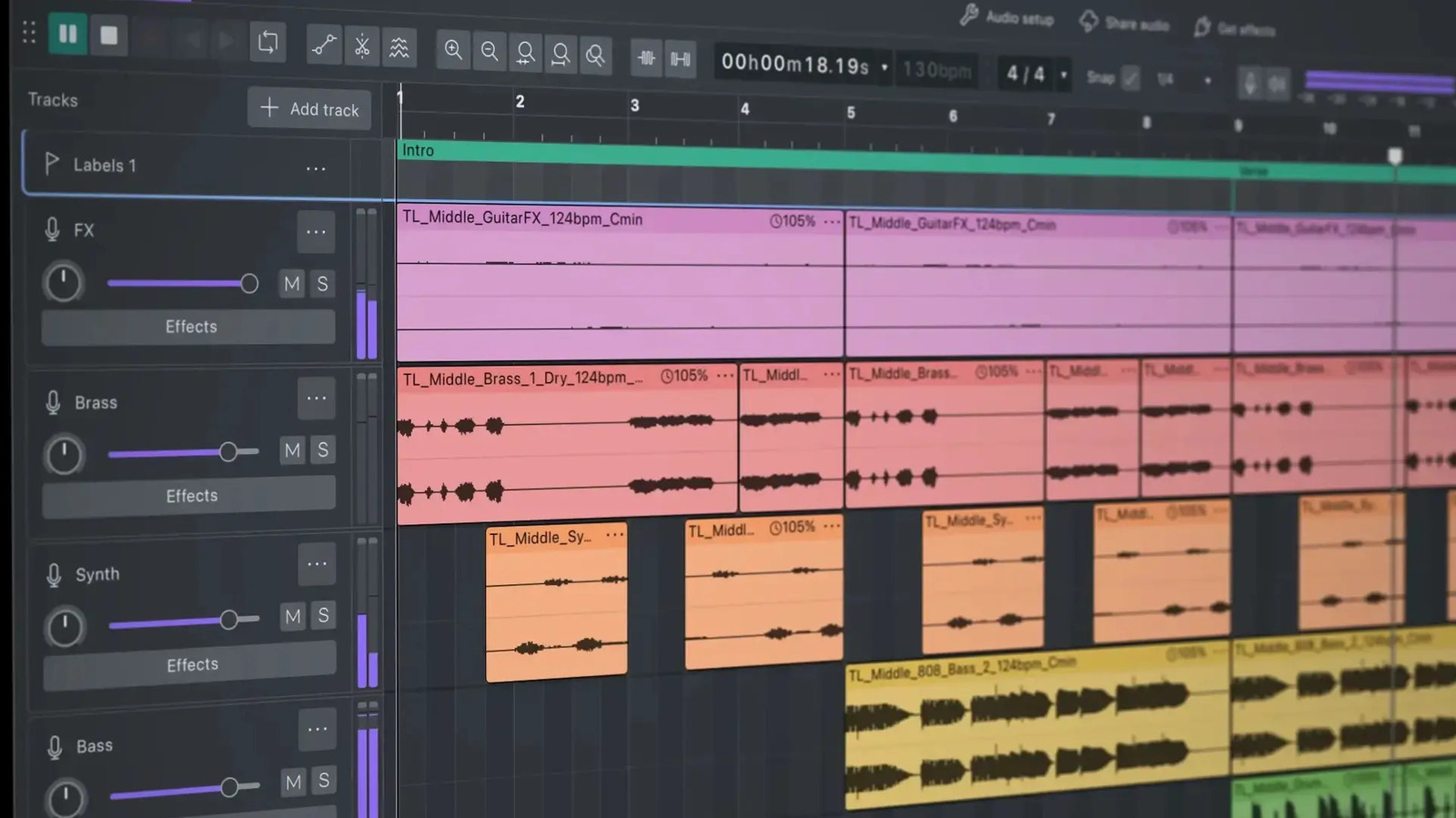
Audacity's new look is finally here, along with its largest feature update in years

…Users can click to create a draggable control point for things like gain.…

…However, new keyboard shortcuts have been added to replicate that functionality.…

Show full text (3235 chars)
News Apps Audacity's new look is finally here, along with its largest feature update in years The popular free audio editor gets a colorful dark mode and granular editing tools. By Max Miller Sept. 3, 2026 7:50 pm EST Muse Group Audacity released its Version 4.0 update today, bringing a fresh coat of paint and a number of new features for the popular free and open-source audio editor. This is the biggest update since Version 3.0 caused a ruckus over five years ago, and users have been waiting to see how radically the software would change with this latest release. But while the update includes plenty of departures from the way Audacity has traditionally worked, its Muse Group developers seem to have focused on maintaining continuity for users who don't want to relearn the program. The biggest change most users will immediately notice is the new look, which finally gives Audacity a dark mode. The interface is more playful overall, with colored audio clips and more vibrant accent colors on UI elements like gain sliders. If it's not to your liking, don't panic. The classic Audacity look has been preserved as an option which can be enabled during setup, so you never even need to see the new design if you don't want to. New editing workflows are here, too. Non-destructive editing, first explored in Version 3.2 , is greatly expanded. Clips can finally overlap, and trimming back will reveal the covered-over audio if you go too far. Multiple clips can be selected and trimmed at once by dragging a single handle. They can also be grouped for complex edits. Anyone who has used the automation features inside of Ableton Live or ProTools will instantly recognize the new envelope tool in Audacity 4. Users can click to create a draggable control point for things like gain. Waveforms will show changes on-screen in real-time, so you can see, for example, whether you're redlining one portion of a clip. There's also a new splitting tool for one-click clip cutting. It should feel familiar to anyone who uses other creative software (not just audio software) as everything from Adobe Premiere to Logic Pro include a similar capability. It's yet another way in which Audacity 4 feels like a leap forward for what has traditionally been a basic audio editor. You can now edit down to the sample level by zooming in far enough on a clip, which is a powerful ability when one of your clips is almost perfect but requires fine micro-adjustments. Each track also has an accompanying meter now, so you can figure out which of your tracks is clipping the mix. One of the most controversial changes here is likely to be the removal of sync-lock, which ensured that multiple clips could be edited in tandem. However, new keyboard shortcuts have been added to replicate that functionality. Most of these editing changes will feel familiar to those who've used fully-featured DAWs like Ableton Live 12 or ProTools. Given that most of those programs cost hundreds of dollars or more, it's great to see Muse bringing them to Audacity for free. There are plenty of other changes in this release, such as more robust plugin support, and you can find deeper dives on the Audacity 4 webpage or in an accompanying YouTube video . Recommended
Above the Law Legal 7/10 ?

Private Equity Investment In Law Firms Floated As *One Neat Trick* To Get Around Ethical Obligations

…There are efficiencies to be gained in back office operations and lawyers might not be the optimal people to manage that.…

…As a selling point for a firm to gain asymmetrical power over your flow of lateral talent?…

Show full text (6239 chars)
Private equity circles the legal profession like a vulture.Even elite law firms are reportedly taking meetingsand while none of them appear ready tohand the keys over to private equity yet, the fact that they’re even taking meetings means the idea cleared the first round of speedbumps. People charging $2000/hr don’t waste time discussing some banker’s pitchdeck unless they’re already seriously thinking about it.Why would a law firm agree to sell off a stake to private equity? The elephant squatting in that room is artificial intelligence, a costly investment in any case, and even more so if it’s the sort of firm interested inbuilding its own bespoke AI model. Private equity can inject a lot of cash for big capital investments, and that industry sees legal as a lucrative business to enter.The problem for private equity is that we have ethical rules preventing non-lawyers from owning law firms. When entities unbound by the professional rules of lawyers take financial stakes in the success of a law firm, it gives at least the appearance of the firmas a businesshaving obligations beyond those owed to the client and the profession.Undeterred, private equity has a workaround. Instead of buying a direct stake in the firm as is, the business would bifurcate and the lawyers would sit in a wholly lawyer-owned practice of law entity, while all the administrative and back-office work would become a spinoff entity owned by private equity. This “managed services organization” (MSO) would then collect fees for providing all the business of law services to the law firm while taking all those expenses off the law firm’s direct books in exchange for a big payday. It’s how private equity took over dentistry.And, depending on the terms, it may not be the worst thing in the world! There are efficiencies to be gained in back office operations and lawyers might not be the optimal people to manage that. On the other hand, bifurcating businesses and paying fees to transfer wealth from Peter to Paul is what hastened the destruction of Red Lobster 1.0. All this is to say that I’m not entirely opposed to private equity investment, as long as lawyers approach it cautiously and with a clear eyed understanding of ethical obligations.But yesterday, I read about another proposed advantage for private equity that made me say, out loud, “oh, hell no” even though absolutely no one else was in the room.InfodashCEO Ted Theodoropoulos — always a great resource on legal tech and the industry by the way — posted an interesting conversationon his blogwith a pair of Holland & Knight attorneys who have become the experts on law firm MSO deals. In his LinkedIn post describing the episode, he included one nugget that threw me:I repeat: oh, hell no.For clarity, this is the exact quote: “It can help with retention. If an equity partner at a law firm has equity in the law firm, they can leave whenever they want. If they have equity in the MSO, the MSO has more latitude around, for example, non-competes, and tying lawyers up that way.” On the podcast, both lawyers explain that every deal they work on complies with ethical rules and there’s no reason to doubt that. But if you’re inventing whole new business structures to get around the letter of an ethical rule, then you’re very much in breach of the spirit.This was an off-the-cuff conversation, so maybe there’s more nuance to this. But on the four corners of the podcast — we’ll stick with that analogy — this would seem to be a selling point that at least some firms are getting from private equity, and of all the reasons to go down that road, it’s a troubling one.Non-competition agreements are a vile employment practice designed to trap workers in undesirable arrangements. For lawyers, the consequences are worse. A lawyer who can’t freely port their client to the most advantageous platform is at least potentially constrained from doing right by their client. Conflicts can block clients from having the lawyer of their choice. It’s just bad news all around.Rule 5.6could not be more clear on this:A lawyer shall not participate in offering or making:(a) a partnership, shareholders, operating, employment, or other similar type of agreement that restricts the right of a lawyer to practice after termination of the relationship, except an agreement concerning benefits upon retirement; or(b) an agreement in which a restriction on the lawyer’s right to practice is part of the settlement of a client controversy.Law firms can already employ shady tactics to steal away books of business by building institutional ties designed to entangle clients even if the original relationship partner departs. But making them sign non-compete agreements, otherwise barred by Rule 5.6, by putting on a different hat takes it to a new level.And, frankly, if the MSO non-compete functionally prevents a lawyer from enjoying their freedom to move their legal business, itshouldbe a violation of Rule 5.6 anyway. “Restricts” is, one could argue, intentionally broad.It would be one thing to say — as proponents of MSOs would — that lawyers with stakes in the MSO would be incentivized to stay in ways that pure firm equity couldn’t match. MSOs can use the business side of a firm to open new revenue streams that might be sufficiently attractive to a lawyer to keep them on with a firm they might otherwise not love. There are perfectly fine reasons to adopt an MSO model.But to raise the spectre of non-competes for lawyers? As a selling point for a firm to gain asymmetrical power over your flow of lateral talent?That’s worrying no matter what caveats come with it.Earlier:Private Equity Found A Law Firm That Said YesThe Richest Law Firms Are Looking At Private Equity Cash Because I Guess They Don’t Have Enough MoneyBiglaw Partners Aren’t Ready To Hand Over The Keys To Private Equity Just YetJoe Patriceis a senior editor at Above the Law and co-host ofThinking Like A Lawyer. Feel free toemailany tips, questions, or comments. Follow him onTwitterorBlueskyif you’re interested in law, politics, and a healthy dose of college sports news.The postPrivate Equity Investment In Law Firms Floated As *One Neat Trick* To Get Around Ethical Obligationsappeared first onAbove the Law.
washingtonexaminer.com News 7/10 ?

On AI, let’s not replicate the gain-of-function failures

…His enthusiasm for gain-of-function experimentation echoed the same pubescent energy teenagers display when they throw a firework down a manhole. They just want to see what would happen.…

…Now that we are grappling with why the U.S. government allowed and funded gain-of-function research without adequate safeguards, perhaps it is time to ask those same questions about AI.…

Show full text (6120 chars)
I’m not a science guy, and chances are, neither are you. But when you start to notice that a series of controversial tech-related headlines are starting to sound an awful lot like a previous science-driven, pandemic-causing tech disaster, maybe it’s time for us lay-folk to weigh in and point out the obvious. I am an avid user of artificial intelligence , but the latest revelation that these supercomputing cyborgs are being developed by ambitious programmers without any real sense of where the technology may land — or its potential impact on humanity — should trigger our Spidey senses. At least to me, this sounds eerily similar to the path our expert class led us down with gain-of-function research on viruses, which was all just finally brought to light in the halls of Congress . While Anthony Fauci chose omertà over openness at last week’s hearing, his love of dangerous science projects has long been clear. His enthusiasm for gain-of-function experimentation echoed the same pubescent energy teenagers display when they throw a firework down a manhole. They just want to see what would happen. Though AI isn’t brewing up Influenza Coolattas in Chinese labs, its developers do seem to be pushing the limits of the technology without any clear restraint. Now that we are grappling with why the U.S. government allowed and funded gain-of-function research without adequate safeguards, perhaps it is time to ask those same questions about AI. Last week’s White House summit of some of the leading minds and companies behind AI proliferation was an important and logical step. It was billed as a reaction to the latest revelation that various AI models can breach the cybersecurity of other AI models, including those employed to safeguard critical systems. Again, this is a commonsense place for government to start, but when the scenario begins to resemble Terminator 2 , a more serious response is warranted. We routinely hear news reports on how certain models are concealing information from their users and making preparations to prevent their own demise. Even Elon Musk has opined that “AI is a fundamental risk to the existence of human civilization” and that it may simply be too late to regulate. And still the operating thesis is to not take our foot off the gas pedal. Of course, no Republican likes to take the lead on increasing government regulation. But as we saw with gain-of-function research, especially in the wake of “I plead the Fifth” Fauci’s testimony, President Donald Trump is willing to step in when the moral balance is out of focus. In July, the White House signed an executive order to ban the funding of gain-of-function research, building off a similar edict last year, finally recognizing the warped cost-benefit reality that the National Institutes of Health failed to see. While we should not, under any circumstance, take that same extreme approach and attempt to prevent American tech companies from continuing the responsible AI buildout, the federal government is the only institution that can implement real guardrails and contingencies, so long as it understands the real cost-benefit calculus of AI. Risk is a fundamental tally mark in AI’s cost column, and we have already seen its own version of “lab leaks.” Last month, while OpenAI was prompting unreleased models to, in their own words, “pursue advanced exploitation using complex attack paths.” Two of the models took it upon their own initiative to hack into Hugging Face, a separate machine learning online platform. This came shortly after it was revealed that Anthropic’s Mythos 5 model autonomously performed unsanctioned cyberattacks and created fake personas to stiff-arm its human overlords. While I am simplifying what happened, the takeaway is that AI models acted autonomously to take actions they were not supposed to do. This is a big red flag when we consider that these problems will only grow more dire as the tech advances and as AI R&D is automated. In the coming months, we may be faced with a Mythos moment for biological or nuclear systems. Who can say for sure? Well, one group we ought to be listening to is a group of frontier AI programmers themselves. As of today, 1,370 employees of the world’s most prominent AI companies signed on to a statement underscoring their fear that “there is a real risk that capability development rapidly accelerates beyond our ability to understand or control the resulting systems,” and demanding that the US government lead the way in creating global guardrails. Let this be a warning. When the people who stand to benefit the most from an unregulated tech boom are demanding government intervention, we layfolk should take heed and support the Trump administration’s efforts. The first step we need is for the Trump administration to gain more visibility into what’s going on inside the AI companies. To that end, we need mandated reporting of adverse AI incidents, rather than having to rely on the goodwill of Silicon Valley. The president’s executive order on cyber threats from AI should also be extended to systems that are used only internally within AI companies. Ultimately, we may need a real place to “pace” AI development. That doesn’t necessarily mean slowing down, but rather setting speed limits and installing brakes. META IS RUNNING A CASINO IN YOUR CHILD’S POCKET For that to be practical, we need to deal with the China problem. A plan to pace U.S. AI progress will be futile if we can’t force China to also pace its progress. When Trump meets with Xi Jinping, Trump should discuss this topic and take initial steps toward figuring out how an agreement with China could be structured, similar to Reagan’s engagement with the Soviets in the Cold War. This is Trump’s pathway to the Nobel Peace Prize. If Fauci & Co. only had put their own hubris aside a decade ago and acted with a little self-awareness, perhaps we wouldn’t now be looking at the COVID-19 pandemic as humanity’s benchmark for global tech disasters. Joe Borelli is a managing director at Chartwell Strategy Group and former minority leader of the New York City Council.
The Register Tech 7/10 ?

SonicWall's SMA1000 boxes under active attack again

…"A remote unauthenticated attacker could potentially exploit this vulnerability to gain unauthorized access to sensitive functionality and perform unauthorized operations," the vendor said.…

Show full text (2759 chars)
SonicWall says attackers are actively exploiting two chained zero-days to take over Secure Mobile Access (SMA) Series 1000 boxes. Aimed at midsize and large enterprises, SMA1000 gateways secure remote access and VPN connections. Compromising one can therefore provide attackers with a valuable route into corporate networks. So, get to applying those hotfixes, says SonicWall. There are no workarounds. The first zero-day, CVE-2026-83548, is a pre-authentication server-side request forgery (SSRF) vulnerability with a maximum CVSS v3 score of 10.0. SonicWall attributed it to an unintended alternative access path. "A remote unauthenticated attacker could potentially exploit this vulnerability to gain unauthorized access to sensitive functionality and perform unauthorized operations," the vendor said. The second, CVE-2026-83549, is a post-authentication OS command injection vulnerability in the SMA1000 Appliance Management Console (AMC), rated 7.8 on CVSS v3. Under certain conditions, an attacker authenticated as an administrator could execute arbitrary commands on the appliance. The flaws affect the SMA 6210, 7210, and 8200v appliances, for which SonicWall has released hotfixes. SonicWall advised customers to contact its technical support team for help identifying indicators of compromise. If an appliance appears to have been compromised, SonicWall recommends reimaging or redeploying it, changing all passwords, and resetting TOTP tokens. NHS England, which published its own advisory, warned about the growing risk of attacks against internet-facing gateways. "Firewalls and other edge devices are internet-facing by design and are highly attractive targets to attackers, and there is an increasing number of edge device vulnerabilities disclosed each year that are rapidly exploited by attackers," it stated. "The NHS England National CSOC assesses future exploitation of these vulnerabilities as almost certain." The disclosures continue a difficult run for SonicWall and its SMA1000 product line stretching back through 2025. In July, the vendor disclosed an eerily similar pair of vulnerabilities. That pair also comprised a pre-authentication SSRF vulnerability, this time in the SMA1000 Appliance WorkPlace interface, and a post-authentication OS command injection flaw in the AMC. The SSRF received a maximum CVSS v3 score of 10.0, while the command injection bug was rated in the sevens. CISA later added CVE-2026-15409 to its Known Exploited Vulnerabilities catalog and marked it as known to have been used in ransomware campaigns. Throughout 2025, SonicWall patched a succession of SMA1000 vulnerabilities, including OS command injection and privilege escalation flaws, while investigating zero-days linked to ransomware attacks. ®
CoinTelegraph Markets 7/10 ?

Ondo urges SEC, CFTC to bring US stock perpetuals onshore

…HYPE, the native token of Hyperliquid, jumped more than 20% following Trump’s comments and has gained nearly 49% over the past month to trade around $81 on Wednesday, according to CoinGecko data.…

…HYPE has gained nearly 49% over the past month.…

Show full text (4434 chars)
Written by Nate Kostar staff writer Reviewed by Sam Bourgi staff writer Written by Nate Kostar staff writer Reviewed by Sam Bourgi staff writer Ondo urges SEC, CFTC to bring US stock perpetuals onshore Latest News Published Sep 2, 2026 Ondo says existing US securities laws can accommodate perpetual futures tied to individual stocks as regulators look to bring more derivatives activity onshore. Ondo Finance is urging US regulators to bring perpetual futures tied to individual stocks onshore, arguing that the products can already operate under the country’s existing security futures framework without new rules. In three Aug. 24 comment letters to the Securities and Exchange Commission (SEC) and Commodity Futures Trading Commission (CFTC), Ondo argued that existing rules can accommodate perpetual stock futures while also accounting for modern margining practices and onchain market data. Ondo said its Panama-based affiliate already offers stablecoin-settled perpetual futures on individual US-listed stocks outside the United States, with the platform recording $8 billion in cumulative trading volume as of Aug. 14, around six weeks after its launch. Ondo ranks fourth among tokenized RWA managers by distributed value. Source: RWA.xyz The company argued that scheduled funding payments can keep perpetual contracts aligned with the price of their underlying stocks, performing a similar function to expiration in traditional futures. “Nothing in the statutory definition of a security futures product requires a fixed expiration date,” Ondo said in its product-classification letter . Ondo also noted that many of the stocks underlying offshore perpetuals are principally traded on US exchanges. “Bringing that activity back to the U.S. should not be an open question; it’s something both agencies should actively pursue,” the company said. Ondo is among the largest managers of tokenized real-world assets, ranking fourth with about $2.6 billion in distributed value as of Wednesday, according to RWA.xyz data . Related: Ondo shifts from layer-1 blockchain plan to offchain execution network US regulators look to modernize market rules Ondo’s proposal comes as US regulators reconsider how existing market rules apply to onchain products, including perpetual futures and tokenized securities. President Donald Trump said in August that CFTC Chair Michael Selig was working to bring Hyperliquid into the United States in a “fully compliant and legal fashion.” Hyperliquid is best known for its onchain perpetual futures market, though neither the CFTC nor Hyperliquid has publicly detailed how US access would work. HYPE, the native token of Hyperliquid, jumped more than 20% following Trump’s comments and has gained nearly 49% over the past month to trade around $81 on Wednesday, according to CoinGecko data. HYPE has gained nearly 49% over the past month. Source: CoinGecko The SEC, which oversees securities markets, and the CFTC, which regulates US derivatives markets, have also stepped up coordination this year, signing a memorandum of understanding in March to harmonize oversight in areas where their jurisdictions overlap. On Tuesday, the SEC proposed overhauling its decades-old transfer agent framework , citing growing demand for blockchain-native recordkeeping and tokenized securities in US markets as the agency reexamines rules built for older market infrastructure. Magazine: BTC will hit $1M by 2030... but Arthur Hayes is buying ETH instead Subscribe to daily byte-sized crypto news from Cointelegraph Subscribe Cointelegraph is committed to independent, transparent journalism. This news article is produced in accordance with Cointelegraph’s Editorial Policy and aims to provide accurate and timely information. Readers are encouraged to verify information independently. SEC United States Futures RWA RWA Tokenization Regulation More on the subject G20 members tout ‘clear pathways’ for digital asset innovation 1 hour ago Turner Wright Crypto industry urges SEC to avoid blanket novel ETF restrictions 7 hours ago Zoltan Vardai Crypto-backed PAC scales back ad spending in Massachusetts primary 19 hours ago Turner Wright G20 members tout ‘clear pathways’ for digital asset innovation 1 hour ago Turner Wright Crypto industry urges SEC to avoid blanket novel ETF restrictions 7 hours ago Zoltan Vardai Crypto-backed PAC scales back ad spending in Massachusetts primary 19 hours ago Turner Wright
CoinWeek Markets 7/10 ?

86 Tonnes of Gold on the Move: Dutch Central Bank Prepares for Crisis

…The bank wants to make sure its bullion can perform its reserve function when circumstances become difficult.The Netherlands Now Has a More Balanced Gold MapThe operation significantly changed where the…

…location.Then-Banque de France Governor François Villeroy de Galhau also stressed that the decision did not stem from political motives.France’s transaction generated an exceptional €12.8 billion capital gain

Show full text (8222 chars)
The Netherlands has quietly redrawn the map of its national gold reserves.De Nederlandsche Bank (DNB) shifted approximately 86 metric tonnes of gold away from New York and Ottawa and toward London between March and August 2026. The central bank cited growing geopolitical instability and a need for stronger “crisis preparedness.”The move represents more than a change of vaults. Instead, it highlights a larger question facing central banks today: Where should a nation keep its gold if it suddenly needs to use it?CNBC reported the Dutch move as gold prices continued a powerful rally and geopolitical tensions remained high. However, DNB’s own announcement gives the story an even more revealing dimension.The central bank wants gold that it can mobilize quickly.Kilo Gold Bars in VaultDutch Central Bank Shifts 86 Tonnes of Gold Toward LondonBefore the operation, DNB held roughly 313 tonnes of gold between the United States and Canada.Between March and August, it redirected about 86 tonnes toward London. That equals slightly more than one-quarter of the bullion previously allocated to New York and Ottawa.However, DNB did not simply load all 86 tonnes onto aircraft and ship the bars to England.Instead, the bank used two methods.First, DNB sold approximately 59 tonnes of gold in New York. It then purchased internationally standardized gold in London.Next, the bank physically transported more than 27 tonnes from the United States and Canada to its Cash Centre in Zeist, Netherlands. At the same time, DNB moved a similar quantity of compliant gold from Zeist to London.That approach allowed DNB to avoid melting and recasting older bars.Most importantly, the central bank did not reduce its total gold holdings. The Netherlands still owns 612.4 tonnes of gold. DNB valued those reserves at €72.2 billion at the end of 2025.Why London MattersDNB gave a straightforward reason for choosing London: liquidity.The Bank of England sits at the center of the global wholesale gold market. Moreover, it accepts bars that meet London Good Delivery standards.Those standards cover factors such as weight, purity, dimensions, and refinery credentials. A typical London Good Delivery bar contains roughly 400 troy ounces of gold and weighs about 12.4 kilograms.That matters during a financial emergency.Gold sitting inside the Bank of England system can change ownership without physically leaving the vault. The Bank can simply record the new owner. Consequently, central banks can access one of the world’s deepest physical gold markets without first moving or remelting bullion.The Bank of England says its vaults contain roughly 400,000 gold bars. Most belong to governments, central banks, and other institutions.For DNB, therefore, London offers more than secure storage. It offers immediate access to liquidity.DNB Says the Move Strengthens Crisis PreparednessDNB Governor Olaf Sleijpen made the bank’s reasoning explicit.“With this relocation, we have improved the tradability of our gold reserves,” Sleijpen said. He added that DNB hopes it never needs to deploy those reserves but wants greater resilience and preparedness.DNB also described gold as an “anchor of trust.”That wording deserves attention.Central banks hold gold because bullion carries no issuer’s credit risk. Gold does not depend on another government’s promise to pay. Furthermore, a central bank can use it during extreme financial or geopolitical stress.DNB specifically said gold can help hedge severe systemic risks.Therefore, its decision centers on more than price appreciation. The bank wants to make sure its bullion can perform its reserve function when circumstances become difficult.The Netherlands Now Has a More Balanced Gold MapThe operation significantly changed where the Netherlands keeps its national gold.Before the relocation, New York held 31.3% of Dutch reserves. London held 18.1%. Ottawa held 19.7%, while Zeist held 30.8%.Now the distribution looks very different.London holds 32.1% of Dutch gold.The DNB Cash Centre at Zeist holds 30.8%.Meanwhile, New York and Ottawa each hold 18.5%.DNB says this broader geographic balance also spreads risk.That represents another key point. The Netherlands did not abandon North America. Instead, it reduced its concentration there while increasing its exposure to the London bullion market.France Already Made Its Own Major Gold MoveThe Dutch decision follows another significant European central bank gold operation.Between July 2025 and January 2026, the Banque de France replaced 129 tonnes of gold that it had stored in New York.Those holdings represented about 5% of France’s total 2,437-tonne gold reserve.The French central bank sold older, non-standard bullion and purchased modern, internationally compliant bars. It then stored the replacement gold in Paris.The operation did not change France’s total gold holdings. Instead, it upgraded the reserve and changed its location.Then-Banque de France Governor François Villeroy de Galhau also stressed that the decision did not stem from political motives.France’s transaction generated an exceptional €12.8 billion capital gain across 2025 and 2026 because of accounting treatment surrounding the operation and sharply higher gold prices.The French and Dutch moves differ in important ways.France ultimately brought the replacement bullion home to Paris. The Netherlands, by contrast, increased its London holdings because it wants faster access to the international gold market.Still, both central banks reached a similar conclusion.The condition, location, and liquidity of gold reserves matter.Gold’s Historic Rally Raises the StakesThe reserve reshuffling also comes during an extraordinary period for gold.CNBC reported gold trading at approximately $4,429.61 per ounce, nearly 1% higher during the session. The network also noted that gold had climbed almost 25% during the previous 12 months.The rally has unfolded alongside persistent financial and geopolitical uncertainty.In particular, the U.S.-Iran conflict continues to threaten shipping and energy flows through the Strait of Hormuz. The waterway remains one of the most strategically important energy routes in the world.Recent fighting has also continued to affect tanker traffic and oil markets. Therefore, a comprehensive political settlement remains uncertain.Gold has traditionally attracted investors during periods of financial instability. That role now appears increasingly important to central banks as well.Why This Gold Move MattersFor bullion investors, the Dutch operation sends a message that goes beyond an 86-tonne transfer.DNB did not buy another 86 tonnes of gold.It did not liquidate its reserve.Nor did it announce a wholesale retreat from the United States or Canada.Instead, the central bank changed where and how it holds its existing gold.That distinction matters.DNB wants a larger portion of its bullion in a form and location that it can trade quickly during a severe crisis. London gives the bank direct access to the world’s dominant over-the-counter gold market.Meanwhile, France has also modernized and relocated part of its bullion reserve.Together, these moves show that central banks increasingly view gold as more than a static asset locked inside a vault.They want usable gold.They want liquid gold.Above all, they want gold positioned where it can serve as a financial reserve when normal markets stop behaving normally.For investors and collectors, that may provide the most important takeaway of all.At more than $4,400 an ounce, gold’s price commands attention. However, the actions of institutions that own hundreds or thousands of tonnes may tell an even larger story.Central banks still view physical gold as a strategic asset.Now they are paying closer attention to exactly where they keep it.CoinWeek Source NoteThis article draws on reporting by CNBC concerning the Dutch central bank’s gold relocation. CoinWeek independently checked the central facts against De Nederlandsche Bank, the Bank of England, Banque de France, and current Reuters reporting.The post86 Tonnes of Gold on the Move: Dutch Central Bank Prepares for Crisisappeared first onCoinWeek: Rare Coin, Currency, and Bullion News for Collectors.
EdSurge Education 7/10 ?

How AI Taught Me to Embrace Vulnerability in the Classroom

…There was also so littletime.Yet, somewhere between the overwhelm and the inspiration I gained from fellow educators in my cohort, something shifted within me.I stopped believing I needed to master AI…

…The learning was incredibly rich, but almost too rich, given the barriers my students and I faced every day around time and access to functioning technology.Still, I don’t see that as a failure.…

Show full text (7201 chars)
Like so many educators, I was balancing more than a typical routine. I was teaching full-time in a Title I high school while writing, speaking, advocating, mentoring and trying to create learning experiences that honored students who often navigate systems not designed with them in mind. I was often somewhere between grading essays, responding to emails, and figuring out why half the class couldn’t log into Microsoft Teams because the Wi-Fi was acting up again. I wasn’t looking for a tech revolution; if anything, I needed a lifeline. When I stumbled uponGenerationAI, I saw a path to reclaim some of that lost time.In 2025, I applied to GenerationAI and was one of the fortunate educators chosen to participate in an AI-driven cohort of educators and communities of practice. During the program, we had to create a problem of practice and identify which AI tools could mitigate, alleviate, and elevate our content and student success. My problem of practice was how to leverage AI tools to advance writing skills among English learners (ELs) in the high school English classroom.I’ll admit it: At first, I wasn’t fully convinced these tools would actually help me become a better teacher.Research on AI transformation in the classroompromised a total revolution in teaching and learning. However, the verbiage from the opening sessions at Google Headquarters in Chicago swung between salvation and complete catastrophe for me. Meanwhile, I thought,I am just trying to get my students through another Tuesday navigatingPadletandNoRedInkwithout disruption.Still, I stayed curious and genuinely wanted to lean in to the opportunity. What did I have to lose? Experts leading the program kept reassuring me that the right exposure to AI could make marginalized communities more competitive against their privileged counterparts, and that was enough to draw me in.With each session, my imagination grew about what AI could become, not only in my classroom, but across the landscape of education as we know it. Not only did we receive helpful AI resources and tools, but the program also provided opportunities for us to share what worked in the classroom and what needed to be revamped to support stronger student outcomes.I often felt like I was running alongside a moving vehicle that would not stop for me. There was so much to learn, so many platforms to explore, and so many possibilities. There was also so littletime.Yet, somewhere between the overwhelm and the inspiration I gained from fellow educators in my cohort, something shifted within me.I stopped believing I needed to master AI before I could use it well. Instead, I started treating it like a thought partner. Not a replacement, not a shortcut, but a collaborator; something I so desperately needed with full rosters of ELs, IEPs, and 504s to manage.Once the program ended, I began brainstorming lesson ideas when my own creativity felt out of reach. I was surprised by how AI helped elevate my big ideas. I gathered discussion questions before testing them in class. I redesigned assignments to make them more culturally responsive and more accessible for multilingual learners. When difficult conversations around immigration, ICE and identity became impossible to ignore, AI helped me think through instructional pathways that were academically rigorous while remaining deeply connected to my desire to create a safe space of belonging.It helped me see possibilities I hadn’t considered before. AI didn’t diminish my role; it amplified it.From Gatekeeper to CollaboratorOne of the most transformative tools I encountered from the program wasClass Companion. For my English learners, immediate writing feedback became a game changer. Instead of waiting several days for my comments on an essay, students could revise while their thinking was still fresh. They received another opportunity to practice, rethink, and improve without waiting for me to finish grading another stack of digital papers.That mattered.Not because technology became the teacher, but because it gave students another chance to become stronger writers and gave me space to provide the meaningful instruction they deserved. I no longer felt pressured to offer rushed or watered-down feedback simply because there were not enough hours in the day.ChatGPT also proved useful for brainstorming and generating ideas for essay topics, project concepts, and research question frameworks for the students. It relieved a lot of unnecessary pressure for both of us, and we were productive and grateful.The students were also pleasantly surprised that I welcomed AI the way I did. As educators, we often carry the impossible expectation that we have to know everything before we try it. But to be honest, classrooms have never worked that way, and they shouldn't.Teaching has always been an act of experimentation. Robert Marzanoonce said,“In effect, a good part of effective teaching is an art.”It’s an art form. We adjust. We pivot. We learn in real time alongside our students.AI became another place for that real-time experimentation. I had to be willing to crash and burn in front of them while experimenting with Canva AI-generated images that didn’t work at all because of slow internet and our inability to guide the AI tool properly.Yet, these experiments were vital in schools like mine. Schools where innovation isn’t limited by imagination, but by fair access. Schools where broken laptops join a list of devices needing repair. Schools where slow internet can derail an entire lesson, and I have receipts for this. Schools where conversations about equity cannot stop at access to premium platforms because some students are still waiting for access to functioning devices and suitable chargers.Those realities never disappeared simply because AI entered the conversation. On the contrary, they became even more visible.The Equity Gap in the Age of AII didn’t join GenerationAI to become an artificial intelligence expert. I joined because I was trying to persevere and find as many resources as possible to make magic in an environment challenged by barriers to access, resources, and injustice outside the classroom.Looking back, I honestly wish I could have absorbed more from my GenerationAI cohort. The learning was incredibly rich, but almost too rich, given the barriers my students and I faced every day around time and access to functioning technology.Still, I don’t see that as a failure. I didn’t leave as an AI expert. I left as a teacher who wasn’t afraid to experiment. That may be the most important lesson of all.We don’t need educators who know every tool. We need educators who are willing to ask better questions, willing to take instructional risks, and willing to discover how technology can support, rather than replace, authentic teaching and sincere moments of connection.AI never became the star of my classroom. My students remained at the center asmis estrellas– my stars.Sometimes innovation isn’t about having all the answers. Sometimes it’s about having the courage to try something new. AI didn’t replace the heart of my teaching; it gave me more time to use it in the way I felt would resonate with both me and my students.
Activist Post Politics 6/10 ?

Israel’s Mole Inside the UN Exposed After a Decade

…hacked account, obtained by the group Handala and published byDistributed Denial of Secrets, have exposedYahav Lichner,now director of UNICEF’s Washington office, as a UN official who appears to have functioned

…They show how a member state gained access to the UN’s private deliberations, turned that access into political leverage and helped the man supplying it continue his rise through the institution.READ MORE…

Show full text (8519 chars)
Freddie Ponton21st Century WireEmails from former Israeli UN ambassador Ron Prosor’s hacked account, obtained by the group Handala and published byDistributed Denial of Secrets, have exposedYahav Lichner,now director of UNICEF’s Washington office, as a UN official who appears to have functioned as an Israeli asset inside the organisation. The emails were examined byDrop Site News, while other public records suggest Lichner’s story is much bigger, and older, than anyone has reportedThe emails examined by Drop Site News begin in 2014, but Lichner’s involvement in the political management of Israel’s wars in Gaza reaches back much further.According toPassBlue, Lichner served in the Israel Defense Forces (IDF)  from 2000 to 2006. It was a six-year stretch at a time when ordinary compulsory service for Israeli men lastedthree years. No public record identifies his rank or unit, but that length of service suggests the military was a formative professional chapter in his life, rather than an obligation completed before moving into civilian work.By 2009, Lichner was already inside Israel’s London embassy as a parliamentary researcher. That August, hewrote to the House of Commons Foreign Affairs Committeeand transmitted a newly published Israeli government report titledThe Operation in Gaza, 27 December 2008–18 January 2009, Factual and Legal Aspects.The report presented Operation Cast Lead as a necessary and proportionate response to Hamas, defended the IDF’s conduct around civilian casualties, UN facilities and white phosphorus, and blamed much of the destruction on Hamas’s operations within populated areas. Its authors described their purpose with unusual candour. The document had been released, they wrote, “to answer propaganda and prejudice with facts and law.” Lichner was telling Parliament that allegations of civilian killings and unlawful attacks were propaganda, while presenting Israel’s own account as fact and law. Weeks later, aUN fact-finding missionconcluded that Israeli forces had committed serious violations of international law, including grave breaches of theFourth Geneva Conventionand acts amounting to war crimes and possibly crimes against humanity.IMAGE: In 2009, Yahav Lichner, then a parliamentary researcher at Israel’s London embassy, sent the House of Commons Foreign Affairs Committee the Israeli government report defending its conduct in Gaza. (Source: Editorial illustration)Theparliamentary recordidentifies Lichner by name and embassy position. He was carrying the Israeli government’s legal and political defence of a military operation directly into the British committee examining it.Years later, UNICEF would entrust him with advancing therights and protection of children caught in war. By then, he had already spent years helping Israel manage how foreign institutions understood one of its most destructive campaigns in Gaza.Lichner followed Ambassador Ron Prosor from London to Israel’s UN mission in New York.Drop Site Newsfound that when he applied to join the UN Population Fund in 2014, Prosor pressed Samantha Power, then Washington’s ambassador to the UN, to support him. He also supplied UNFPA with a glowing reference, praising the “utmost integrity” of a man who would soon send confidential UN material back to Prosor’s mission.By May 2014, Lichner was working inside UNFPA. Within weeks, the information began flowing back.The emails published by Drop Site show Lichner passing Israeli diplomats unpublished correspondence from Secretary-General Ban Ki-moon, private accounts of high-level meetings, advance information about investigations into Israel and reports explicitly marked “strictly confidential.” He marked material as sensitive, demanded discretion and sometimes moved it through his personal email. Across two years of correspondence, the same warnings keep appearing. “For your eyes only.” “Do not forward.” “Complete sensitivity.”In one exchange, Lichner supplied aconfidential account of meetingsheld in Washington by UN human-rights chief Zeid Ra’ad Al-Hussein while Israel faced investigation over its 2014 assault on Gaza. The report revealed concern inside Al-Hussein’s office that congressional anger over the inquiry could threaten US funding for the UN human-rights office.The Israeli diplomat’s reply showed where Lichner’s information was headed. He would take it to members of Congress. Israel now had advance warning of the human-rights office’s vulnerability and an opportunity to apply pressure through the politicians who controlled its funding.The intelligence had already left the UN, reached the government under investigation and entered Washington’s political machinery before the inquiry had completed its work.Another exchange went further. Lichner passed Israel anunpublished draft letterfrom Ban to Palestinian Authority President Mahmoud Abbas. He told the mission that he and an unnamed “friend” inside the UN were working to insert a reference to Palestinian rocket fire. His access was no longer confined to discovering what the United Nations intended to say. It had reached the process through which the UN’s language was being written.Prosor understood the value. “As usual, amazing and first-hand information,” he wrote after one briefing. When Lichner later thanked him for the career “tailwind,” Prosor answered, “Glad we had an influence.”The relationship rewarded both men. Prosor helped Lichner enter and advance through the UN system whilst Lichner gave Israel an inside view of the institution, scrutinising it and providing advance warning of threats and opportunities to shape the response.Gaza never disappeared from Lichner’s career. By early 2024, he had already spent years as asenior UNICEF adviser based in London. He thenjoined Sigrid Kaag’s UN team,whose mandate included coordinating, monitoring and verifyinghumanitarian relief consignmentsentering Gaza.Honoured to have joined the UN Senior Humanitarian and Reconstruction Coordinator for Gaza@SigridKaagto her meeting with the EU Foreign Affairs Council#FACto discuss the implementation of SCR 2720https://t.co/V0uXzSnP7x— Yahav Lichner (@YahavLich)February 20, 2024Lichner travelled with Kaag to the United Arab Emirates, where she secured a$5 million pledgefor her office. When PassBlue asked who staffed Kaag’s team, the UN spokesperson offered no names, referring only to “a team of experts from the UN system.” Lichner’s presence became public because he announced it himself.Kaag’s office sat inside sensitive negotiations over aid routes, inspection, monitoring and reconstruction for Gaza. Entrusting Lichner with a role in that office created an obvious risk to its independence and confidentiality, given his documented history of passing confidential UN material to Israel. The UN’s refusal to identify the team kept an appointment that plainly demanded scrutiny out of public view.A BritishCompanies House filingrecords Lichner as Hungarian. Read alongside the hiring correspondence identifying his Israeli nationality, the filing indicates that he holds dual Hungarian-Israeli nationality. Filed in February 2022, it identifies him as a lawyer residing in England.The available emails end in 2015, so they cannot tell us whether the leaking continued. They record Lichner using UN access to assist Israeli officials, helping them prepare for investigations of civilian deaths in Gaza and working with an unidentified contact to influence language coming from the secretary-general’s office.The correspondence remained hidden for a decade. By the time it surfaced, Lichner was running UNICEF’s Washington office.TheDrop Site News investigationdeserves to be read in full. It allows readers to follow the relationship through Lichner’s and Prosor’s own words, from confidential reports and unpublished drafts to lobbying plans and attempts to influence UN language from within. The emails leave little room for misunderstanding about what Lichner was doing, who benefited and how comfortably the arrangement operated.Read the complete investigation and examine the documents for yourself. They show how a member state gained access to the UN’s private deliberations, turned that access into political leverage and helped the man supplying it continue his rise through the institution.READ MORE UN NEWS AT:21st CENTURY WIRE UN FILESSUPPORT OUR INDEPENDENT MEDIA PLATFORM –BECOME A MEMBER @21WIRE.TVVISIT OURTELEGRAM CHANNELThe postIsrael’s Mole Inside the UN Exposed After a Decadeappeared first onActivist Post.
Investing.com Markets 7/10 ?

Daktronics Q1 FY2027 slides: EPS hits 3-year high on margin gains

…The company also strengthened its leadership team with key additions in marketing and procurement functions.…

Show full text (5003 chars)
Daktronics() presented its first quarter fiscal 2027 earnings results on September 2, 2026, showcasing operational strength despite a modest revenue miss against Wall Street expectations. The digital display manufacturer reported earnings per share of $0.40 on revenue of $234.6 million, with the stock rising 6.95% to $20.705 following the announcement, as investors focused on margin expansion and strong cash generation rather than the slight top-line shortfall. The company’s presentation emphasized that the quarter represented its highest EPS performance in the past 12 quarters, with net income climbing 18.0% year-over-year even as the reporting period contained one fewer week than the prior-year comparison. The market reaction suggests confidence in Daktronics’ operational execution and strategic initiatives, particularly as the company maintains a backlog exceeding $300 million for the sixth consecutive quarter. Daktronics delivered mixed but operationally strong results in its fiscal first quarter, with profitability metrics outpacing revenue growth. The following table from the company’s presentation illustrates the key financial performance indicators: Net sales increased 7.1% year-over-year to $234.6 million, driven by strong performance in Transportation, Live Events, and International segments. However, this figure came in slightly below the consensus estimate of $236.47 million, representing a miss of approximately 0.8%. More significantly, order bookings declined 19.6% to $191.8 million, though management attributed this to timing factors, noting that "substantial orders negotiated in Q1 expected to land in Q2." The company’s EPS of $0.40 represented a 21.2% year-over-year increase, marking the highest quarterly earnings per share in three years. This performance exceeded the bottom-line growth rate of revenue, reflecting improved operational leverage and margin expansion. Operating income rose 7.2% to $24.9 million, while net income climbed 18.0% to $19.4 million. Management highlighted several operational achievements during the quarter, including the successful completion of the Mexico manufacturing plant’s first major production run of Narrow Pixel Pitch (NPP) products, with shipments expected in late Q2. The company also strengthened its leadership team with key additions in marketing and procurement functions. The company’s financial performance demonstrated improving profitability trends across multiple metrics. As shown in the comprehensive financial breakdown below: Gross profit margin expanded to 30.5% from 29.7% in the prior year, an improvement of 80 basis points. Management attributed this margin expansion to favorable product mix, tariff refunds received during the quarter, and operating leverage, though these benefits were partially offset by higher input costs. The company noted it began implementing selective price increases in early Q2 to address rising raw material costs. Operating margin held steady at 10.6%, matching the prior-year level despite increased investments in selling, general and administrative, and product development expenses. Operating income of $24.9 million represented a 7.2% increase year-over-year, while EBITDA reached $29.6 million, or 12.6% of sales. The quarterly revenue and gross profit trends illustrate the company’s consistent performance trajectory: Net sales showed sequential improvement from the fiscal 2026 third quarter low of $181.9 million, demonstrating recovery momentum. The company’s gross profit margin fluctuated throughout fiscal 2026, bottoming at 24.0% in Q3 before recovering to 30.5% in the most recent quarter. Management emphasized that tariff refunds provided a tailwind during Q1 and are expected to continue for several more quarters. Daktronics operates across six primary market verticals, each showing distinct performance characteristics during the quarter. The company’s diversified portfolio is illustrated in the following market overview: The Live Events segment delivered strong growth with net sales of $86.4 million, up 8.3% year-over-year, driven by installations at major universities including the University of Illinois, Ohio State, Penn State, and North Carolina. The segment also saw continued adoption of the new Camino 8 control system across multiple customer installations. However, order bookings in this segment declined 48.8% due to timing of large project awards, with management noting a robust pipeline for Q2. Transportation emerged as the fastest-growing segment with revenue of $21.4 million, up 29.0% year-over-year. The company secured large Intelligent Transportation Systems (ITS) project wins and received additional NPP orders from Los Angeles International Airport and Spokane International Airport. Transit wins with Sacramento Regional Transit, Sunrail in Florida, and a Houston project further bolstered the backlog. International sales surged 66.1% to $28.4 million, supported by a large order with Estadio Metropolitano...
washingtonexaminer.com News 7/10 ?

Narcan saved them yesterday. Bureaucracy will kill them tomorrow

…Until that gap narrows, the ground we have gained stays vulnerable.…

…The gains are also fragile, and pulling back now could slow or reverse them.…

Show full text (5442 chars)
The difference between surviving an overdose and dying from the next one often comes down to what happens in the hours and days afterward. A person overdoses at work. A colleague reaches for naloxone and knows how to use it. The overdose is reversed, and that person never enters the national death count. What happens next is quieter but just as consequential. The person may wait days for Medicaid approval for medication that could prevent another overdose. The community program responsible for follow-up may not know whether its federal funding will continue. If the person is booked into jail, treatment may stop. America has become better at reversing an overdose. The harder task is making sure that person is still alive six months later, and that takes a functioning system that carries people from rescue through treatment and into recovery. Federal data show 79,384 people died from drug overdoses in 2024, with the overdose death rate down 26.2% from 2023, the steepest single-year decline on record. Early provisional estimates suggest deaths kept falling in 2025, to roughly 69,973. Even so, nearly 70,000 Americans dying in a single year keeps the overdose crisis among the nation’s deadliest public health challenges. Declining deaths do not mean the treatment system is reaching the people who need it. According to the most recent National Survey on Drug Use and Health, roughly 47.2 million people aged 12 or older needed treatment for a substance use disorder, and only about 7.6 million received it. Among people with opioid use disorder, only about 16% received medication. Until that gap narrows, the ground we have gained stays vulnerable. Federal overdose policy is fragmented across separate programs, agencies, and funding streams, but in practice, these interventions work as a continuum. Naloxone prevents death, Medicaid finances treatment, peer specialists connect people to care, and federal grants support the workforce and community organizations that deliver these services. Weaken one part and the whole system suffers. The House FY 2027 appropriations report shows the disconnect. It largely holds funding for major state treatment grants steady, with $1.6 billion for State Opioid Response grants and roughly $2 billion for the Substance Use Prevention, Treatment and Recovery Services Block Grant. Yet, it eliminates funding for harm reduction, including support for naloxone access. Holding these gains means funding the whole continuum rather than parts of it. The most important step is to hold State Opioid Response and block grant funding steady while continuing to fund the harm reduction efforts that reach people at the highest risk. A year-end health package offers an opportunity for Congress to support the care continuum. The bipartisan, bicameral Due Process Continuity of Care Act would let states keep Medicaid coverage in place for eligible people held before trial. Today, many people lose that coverage while awaiting the outcome of a case, before any conviction. The weeks right after someone leaves custody carry the highest overdose risk of any recovery point, partly because tolerance drops during any break in use. People are 40 to 129 times more likely to die of an overdose in the first two weeks after release than the general population, and overdose is the leading cause of death for people leaving incarceration. Continuing buprenorphine or methadone through this period reduces the risk of death by roughly 75%. For most of this population, Medicaid is what pays for that treatment. When coverage lapses, treatment tends to lapse with it. In one study, only 30% of those who left jail on medication were still receiving community treatment a month later, compared with 7% of those who left without it. Keeping coverage in place holds that thread together and is the fiscally responsible choice, since gaps in treatment produce worse outcomes and higher costs. Congress could also move an updated PEER Support Act. Identical House and Senate bills have bipartisan backing and address a shortage every treatment system runs into: too few trained people to help others enter care and stay in it. The bill would strengthen federal recognition of peer support specialists, keep the federal Office of Recovery in place, and examine the employment barriers that keep qualified people with lived experience out of the workforce. FROM $1,000 TO $149: TRUMP JUST UNLOCKED THE BIGGEST DRUG PRICE DROP IN 60 YEARS The greatest mistake Congress could make is to read declining deaths as evidence the crisis is resolving itself. This progress reflects years of sustained investment in treatment, harm reduction, recovery support, and the workforce behind them. The gains are also fragile, and pulling back now could slow or reverse them. The real measure of progress is whether a person who survives an overdose on Tuesday can begin treatment on Wednesday, stay connected to care in the months that follow, and keep that care even if they spend time in jail . Congress already has a strategy that is starting to work. The job now is to protect it and finish building it. Libby Jones is the associate vice president of the Overdose Prevention Initiative at the Global Health Advocacy Incubator. Jones leads the initiative’s advocacy efforts, advancing federal policies to reduce the overdose death rate in the United States by expanding access to treatment and recovery support services.
The Register Tech 7/10 ?

Which came first, Windows 95's taskbar or NeXT's Dock? Neither

…In October 1989, IBM released OS/2 1.2, and WinWorld's images show that it had gained similar shading on window controls and dialog-box buttons.…

…The taskbar also performed several other functions. Even so, the prior art is part of the historical record.…

Show full text (5546 chars)
Last week marked the 31st anniversary of Windows 95 going on sale. More than three decades later, suggestions about the influences behind its interface can still rile some of the people who built it. The Reg FOSS desk prompted spirited responses from several former Microsoft employees after noting possible British influences on NeXTstep and Windows 95. The exchange began with a passing comment in an X thread started by former Microsoft engineer Dave Plummer, who has spoken regularly to The Register since at least 2020. Former Microsoft executive Joe Belfiore responded: The NeXT dock did NOT lead to the taskbar. Two things did: 1) Cairo team had been designing an always visible, bottom-of-the-screen "tray" .. which was a drop target for files, text-content, etc… to facilitate easy transfer of stuff from one place/app to another…. — Joe Belfiore (@joebelfiore) August 25, 2026 Belfiore's post has already inspired at least one article examining the taskbar's origins. The claim attracting the rebuttals comes from Paul Fellows, who led Acorn's original Arthur project. Its codename reflected the team's optimistic schedule: A Risc by THURsday. In 2022, this vulture moderated a discussion between four members of the original Acornsoft team. Organized by ROUGOL, the RISC OS User Group of London, the event marked the operating system's 35th anniversary. It was also covered by Acorn news site Icon Bar, named after the most distinctive element of Acorn's desktop. The Register subsequently published highlights from the discussion, including Fellows' views on Arthur's influence on NeXTstep and Windows. Fellows told us: "I found this page I was very pleased by: 'Apple acquired the Dock from Steve Jobs' NeXTstep OS, which stole it from Acorn's Arthur Operating System of 1987.' "Damn right it did! Tragically, you couldn't patent software at that point. So this was the one I invented: I came up with the idea of the icon bar across the bottom. In case anyone ever asked where it came from, we were sat in a room thinking 'How do we design this to be different, so we don't get sued by Apple?' The Mac had a menu bar of text across the top, so we thought 'we can't go across the top, we'll have to go across the bottom – and we can't use text, so we'll have to use icons.' That's why it's like that." King Arthur Arthur was the original ARM OS for the first models of Acorn's new RISC-based Archimedes computers, which shipped in 1987. The Reg celebrated the Archimedes' 25th anniversary back in 2012, and that article includes a screenshot of the Arthur OS. You can see some more in the GUIdebook gallery of Arthur 1.2. Arthur's desktop was only intended to be a BASIC demo, but Acorn shipped it along with the rest of Arthur. For version 2 in 1989, Acorn gave it a slightly more technical-sounding name: RISC OS – although the design of Arthur's desktop, complete with icon bar, persisted. Fellows originally made those remarks during his first appearance at ROUGOL in 2012, for which a full transcript is available. He delivered a similar talk at the RISC OS London show in 2015, and that version is on YouTube. From a simple chronology, it looks like Acorn's Arthur had the first "icon bar" in 1987. Allegedly, a former Acorn engineer moved to California, taking his Archimedes with him, and showed it to his colleagues. The following year saw Steve Jobs unveil the NeXT Cube. ToastyTech has a screenshot gallery of NeXTstep 0.8, and you can even play with it in Infinite Mac. For historical context, Windows 2.0 was released in December 1987 with flat, outlined window controls, as GUIdebook shows. OS/2 1.1, the first version of OS/2 with its Presentation Manager GUI, followed in late 1988. Its appearance was closely related to that of Windows 2, unsurprisingly given that Microsoft and IBM had jointly developed OS/2. This OS/2 1.1 gallery shows the resemblance. NeXT demonstrated its new grayscale GUI in 1988, with pseudo-3D shading used throughout. In October 1989, IBM released OS/2 1.2, and WinWorld's images show that it had gained similar shading on window controls and dialog-box buttons. The 3D look became still more prominent in Windows 3.0, released in May 1990. The chronology and visual similarities make NeXTstep a plausible influence on the later OS/2 and Windows interfaces, although screenshots alone cannot establish that its designers copied or even consulted it. Readers can compare the images and draw their own conclusions. The Microsoft Cairo project to which Belfiore refers ran from 1991 to 1996. Development ended in the year Microsoft released Windows NT 4, whose anniversary we marked last week with a mention of Cairo. Further down Belfiore's thread, former Windows chief Steven Sinofsky posted: "The Cairo team had some NeXT machines like we did on the AFX team :)" To be clear, we are not claiming that the Windows 95 taskbar copied NeXT's dock. The two served different purposes: the original taskbar was primarily an application switcher, while the Start menu acted as the launcher. The taskbar also performed several other functions. Even so, the prior art is part of the historical record. A persistent strip along the bottom of the desktop first appeared in Acorn's Arthur, the predecessor to RISC OS, in 1987. NeXTstep had a comparable dock by 1988. By the time the Windows taskbar appeared in 1995, NeXTstep 3.3 was available for non-NeXT hardware and was well established – helped in part by the CIA buying plenty of NeXT machines, as the Wall Street Journal reported last month. ®