Two Florida county election supervisors filed complaints with the FBI last week after federal border agents appeared at early-voting sites in the first two days of early voting. Both incidents now have an official explanation, and one supervisor has accepted it. In Tallahassee, two U.S. Customs and Border Protection vehicles that sat outside Leon County's busiest early-voting site for about 10 minutes on Monday, October 19, belonged to officers who had stopped to ask whether they could vote early before leaving the state on a deployment, according to an FBI account relayed by Earley's office and a statement from CBP. "I accept this account of the incident, as it fits the facts as I understand them," Leon County Supervisor of Elections Mark Earley said on October 23. In Key Largo, masked, armed Border Patrol agents seen on video outside a polling place on Tuesday, October 20, were arresting a man who, CBP says, pulled into a parking lot next to the polling place during a traffic stop. Monroe County Supervisor of Elections Sherri Hodies is still investigating that incident and says that armed agents' presence outside a polling place is prohibited by federal law, a reading no court has tested; she also said the agents appeared to be outside the 150-foot zone Florida law sets around polling places.
Tallahassee: agents who wanted to vote
Earley first reported that the two CBP vehicles had stopped at the Northeast Branch Library and left after about 10 minutes, and that his office had received no calls about it from voters. Early reports identified the vehicles as belonging to Immigration and Customs Enforcement; CBS Miami and other outlets later corrected that to CBP. Earley filed a formal complaint with the FBI. "Voters should never experience intimidation from anyone when they are voting," he said, adding that the bureau was "taking it seriously." Before the FBI's account came out, Thomas Kennedy, a spokesperson for the Florida Immigrant Coalition, said: "To me and to immigration advocacy groups, it smells and feels like an intimidation tactic."
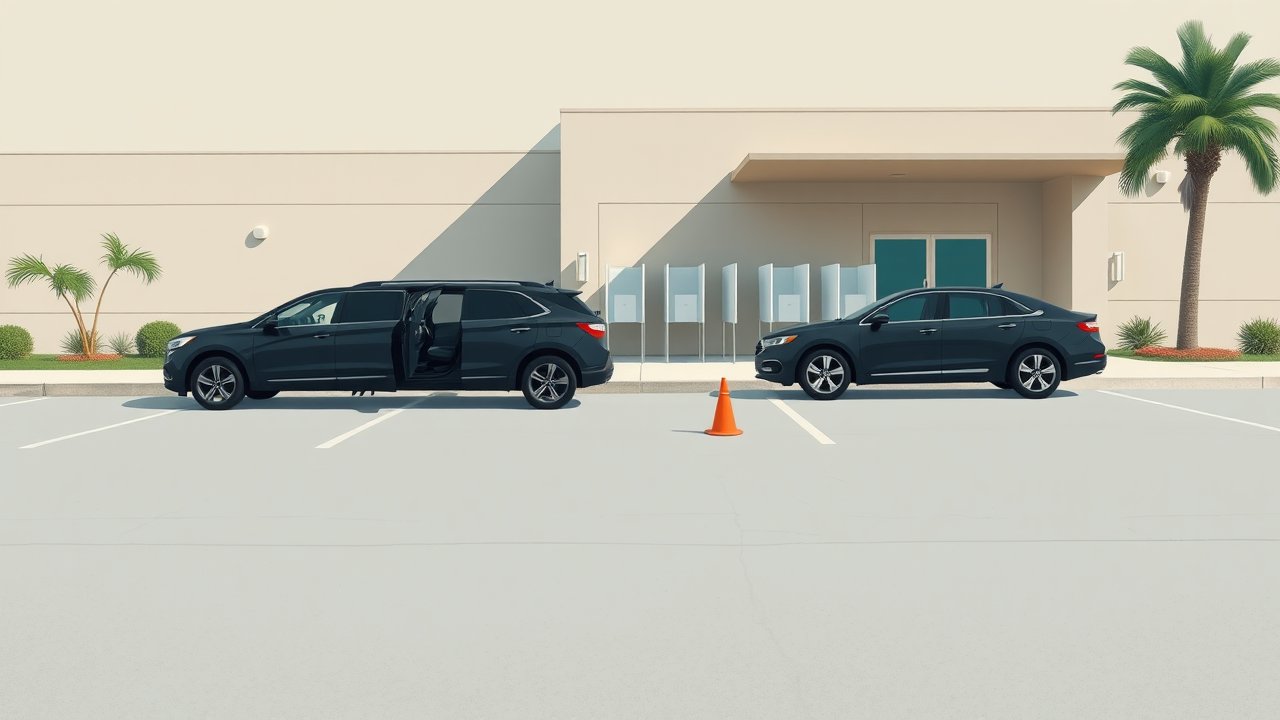
On October 23, Earley's office said the FBI had found that the vehicles belonged to a team of agents normally stationed in South Florida who had been reassigned to another state, and that the agents "thought they could vote at that location, which is incorrect since they were not Leon County voters." When they learned that, Earley said, they "immediately left the early voting site." His office said the team was traveling north out of state on U.S. Highway 319 when it stopped. Earley said he was "satisfied" it was "an isolated instance of agents attempting to vote before they left Florida." CBP said in a statement: "This was not an immigration enforcement action." It said the officers, who were out of uniform, were traveling in a government vehicle "from Florida to Brownsville, Texas, in support of an out-of-state deployment," stopped "to ask whether they could vote early before departing the state," were told they could vote only in their home county, and "promptly departed." "Like all eligible Americans, government personnel may exercise their right to vote," the agency said.
Key Largo: an arrest next to the polls
The Key Largo incident took place just before 1 p.m. on October 20 at the Murray Nelson Government Center, an early-voting site. Video posted by the Key Largo chapter of 50501, an anti-Trump protest movement, showed masked Border Patrol agents in unmarked cars speaking with a man who had been pulled from his vehicle at the center's south entrance. "We do not know why these agents were at this poll," a representative of the group said. CBP said agents from its Marathon station "conducted a vehicle stop on U.S. Highway 1 in Key Largo, Florida, as part of a targeted immigration enforcement operation" to arrest a Malaysian man it said had overstayed his admission to the country and had prior charges for drug possession and battery. "During the vehicle stop, the driver pulled into a nearby parking lot that happened to be adjacent to a polling location," CBP said, and the agents arrested him and left. Charges are not convictions, and the man's own account was not available.
Hodies said that "it appears that when the video was taken, the officers were not within the 150-foot non-solicitation zone" that Florida's election code sets around polling places, but that "the mere presence of armed Border Patrol agents outside a polling place is expressly prohibited by federal law," citing 18 U.S.C. § 592. "We were assured repeatedly by our contacts at the Department of Homeland Security that this would not occur," she said. Her office has contacted the FBI and is pulling the government center's security footage.
What the law says
The federal statute Hodies cited, 18 U.S.C. § 592, makes it a crime for any person in the civil or military service of the United States to order, bring or keep "troops or armed men at any place where a general or special election is held," unless the force is "necessary to repel armed enemies of the United States." No court has ruled on whether either Florida incident falls under it. At a statewide elections conference, the FBI told supervisors there would be no immigration enforcement at polling places, CBS Miami reported. Brevard County Supervisor of Elections Tim Bobanic said officials had been told "time and time again that there are no plans for any of that kind of stuff to happen in Florida."
This article reflects reporting through the evening of Sunday, October 25, 2026. Sources: WCTV, October 23; CBS Miami, October 22; Keys Weekly; Scripps News; 18 U.S.C. § 592.