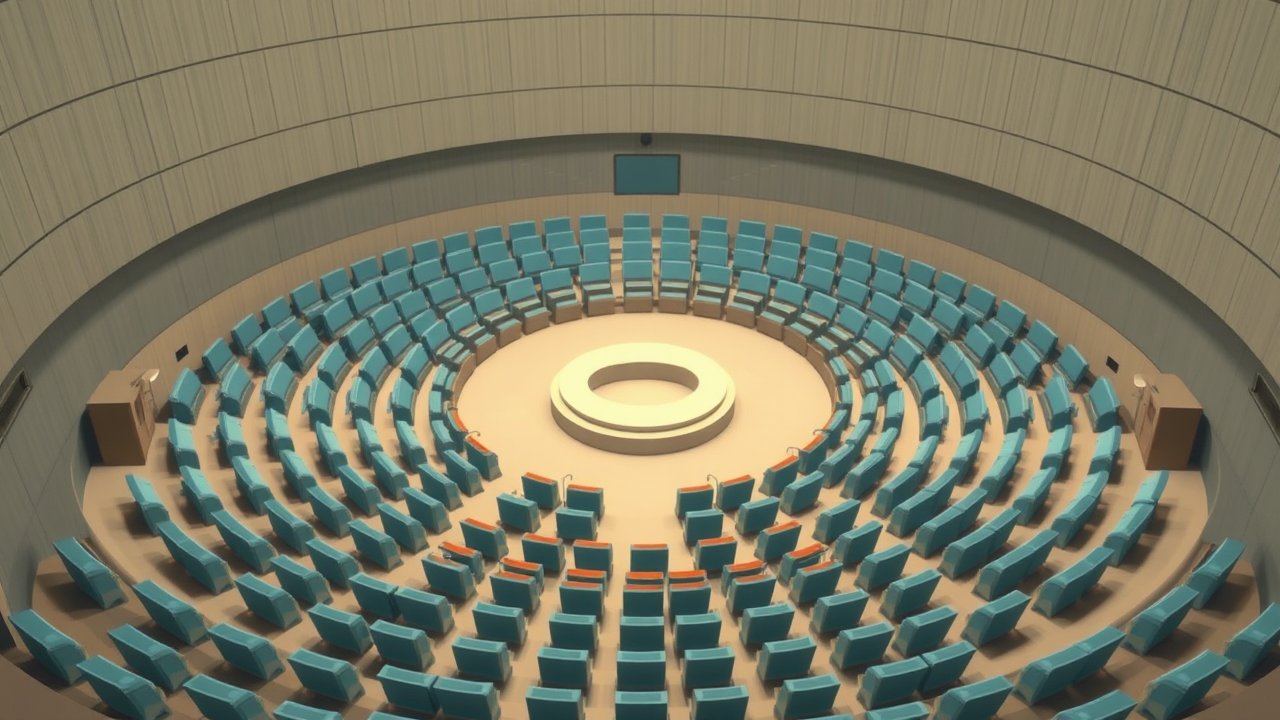
The United Nations General Assembly adopted Cuba's annual resolution calling for an end to the United States embargo on Wednesday, October 28, by 130 votes to 17, with 25 abstentions, according to UN Meetings Coverage. Similar resolutions have passed nearly every year since 1992, AFP noted, and this was the 34th such vote, but it drew 35 fewer yes votes than in 2025 (165 to 7, with 12 abstentions) and 57 fewer than in 2024 (187 to 2). Agence France-Presse called it the weakest backing since 1995 (UN News said two decades). U.S. Ambassador Mike Waltz, who had lobbied governments to vote no, told reporters, "I'm satisfied that so many countries now, including major economies like Korea, like Germany and others have shifted their position." Cuba's Foreign Ministry called the result "a new diplomatic victory for our country" (Profoundd's translation), and Foreign Minister Bruno Rodríguez Parrilla wrote on X that the U.S. government "is once again isolated in its attempt to continue strangling the Cuban people and subjecting them to an act of collective punishment and genocide," as Reuters quoted it.
Apart from the vote and the U.S. expulsion of one Cuban diplomat over an altercation in the General Assembly hall (below), Profoundd found no government that cut, downgraded or suspended relations with Havana between October 27 and 30. Over the year, though, the record does show a sequence: Ecuador expelled Cuba's ambassador and Costa Rica closed its Havana embassy in March, Colombia's incoming president announced a break in July, the Dominican Republic expelled Cuban diplomats in August, and the UN tally fell on October 28.
Who moved, and why they say they did
Ten states that voted yes or abstained in 2025 voted no this year, according to CiberCuba, citing the UN voting record: Bosnia and Herzegovina, Colombia, Costa Rica, Czechia, Ecuador, Lithuania, Morocco, Slovenia, Trinidad and Tobago and the United Arab Emirates. Germany, Italy and Latvia abstained for the first time in decades (Euronews says 34 years; CiberCuba says Germany had voted yes since 2002 and, citing the Italian press, that Italy had not abstained since 1994); Chile, Honduras, Peru, the Dominican Republic and Jamaica also abstained, EFE and CiberCuba reported.
The governments that switched gave their own reasons, and Havana gave a different one. Colombia's Foreign Ministry wrote on X, in CiberCuba's translation, that the vote came "under the instruction of President" Abelardo de la Espriella and showed "a firm stance against authoritarian regimes and those complicit in narco-terrorism". Trinidad and Tobago's prime minister, Kamla Persad-Bissessar, wrote on X, as quoted by CiberCuba, "I have made it clear publicly that Trinidad and Tobago will not support the military dictatorship in Cuba." Jamaica's foreign minister, Kamina Johnson Smith, said, "We did not vote against it because we do not support unilateral actions," as quoted by CiberCuba from the Jamaica Observer; Jamaica's information minister denied any foreign pressure, and the opposition People's National Party asked, "What has changed in 24 hours?" after Parliament's motion on Cuba the day before. Italy's Foreign Ministry said, in CiberCuba's translation, that the embargo "has negative economic and humanitarian consequences for the Cuban people" but that "the decisions of the Cuban authorities are the cause of the current crisis." Havana attributes the shifts to coercion: Rodríguez told the Assembly before the vote that Washington had unleashed "a wave of pressure, intimidation and blackmail on many member states."
Rodríguez added, "I can prove it with a document I have with me" (both quotations are Profoundd's translations of the Foreign Ministry's Spanish text). Waltz told the Assembly on Tuesday that the charge of U.S. reprisals was "a complete and utter lie" and accused Havana of the same thing: "They are threatening countries with reprisals over this vote," according to the U.S. Mission's transcript. Lee Schlenker of the Quincy Institute for Responsible Statecraft, in a piece its publication labels analysis and opinion, wrote of Rodríguez's earlier allegations in Havana that U.S. officials had threatened tariffs and visa denials that he "presented no concrete evidence for the claims," while noting that Secretary of State Marco Rubio had publicly pressed El Salvador's president to "join the United States and like-minded partners" at the UN. Profoundd found no published copy of the document Rodríguez said he had; Waltz's published remarks name no country that Cuba threatened, and no other source Profoundd read reports evidence for that charge.
The clash on the floor
The vote came a day after what the Associated Press called a shouting match between the two delegations, and Al Jazeera "an apparent shoving match." On Tuesday, Rodríguez walked to the podium seeking a point of order and, AFP reported, shouted, "You are a liar!" Waltz responded, in the AP's transcription: "This individual needs to back away from this podium. He's not going to intimidate me in the United States of America."
Waltz said Richard Tur de la Concepción, a first secretary at Cuba's UN mission, would be expelled from the United States for "assaulting an American diplomat," according to a report credited to Al Jazeera staff and Reuters. By CiberCuba's account, Tur was accused of trying to seize the phone of a U.S. official who was recording the confrontation; Responsible Statecraft wrote that he tried to stop one of Waltz's staffers from filming him. Cuba's account differs: in a letter to the Secretary-General dated October 27, Cuba's UN ambassador, Ernesto Soberón, accused the U.S. official, J. P. Freire, of harassing Tur, invading his personal space and continuing to record him despite his objections, according to Martí Noticias, the U.S. government-funded broadcaster to Cuba, and the Caracas-based network teleSUR, and Rodríguez, in his Wednesday speech, denounced "harassment and unconsented filming" of his delegation and called it a maneuver against a Cuban candidacy to a UN body.
The expulsion went ahead. On Thursday, a State Department spokesperson told Martí Noticias that Tur "has left the country" and that Cuban officials had shown "their true nature through their tactics of intimidation and oppression" (Profoundd's translation of Martí's Spanish). The same day Cuba's first deputy foreign minister, Gerardo Peñalver Portal, welcomed Tur home, writing on X that he had faced "the disrespectful and provocative attitude of the U.S. delegation" with dignity and that the U.S. staff's conduct was part of a strategy to hinder the vote and Tur's candidacy to a UN body (Profoundd's translation). Profoundd found no report of a reciprocal Cuban expulsion as of Friday afternoon.
Waltz's case, as UN News and AFP reported it, was that "there is no blockade": U.S. companies exported more than $876 million in goods to Cuba in the first eight months of 2026, so "the plight of the Cuban people is exclusively the fault of this corrupt communist regime." Rodríguez's case was the embargo's cost, shown on an on-screen counter, and a doubling of infant mortality that he attributed to it. "Cuba is not a threat; the blockade is a threat," he said. The UN's resident coordinator in Cuba, Francisco Pichón, has said the tightened embargo has led to an energy crisis and possible humanitarian collapse, UN News reported. The January U.S. order on oil shipments to Cuba and Rubio's October 23 invitation to Cubans to a "discrete partnership" with the CIA are covered in Profoundd's earlier report.
What did not change
A majority of 130 states still voted yes. The resolution is not binding, EFE noted; lifting the embargo depends on the U.S. Congress, CiberCuba pointed out. Mexico's UN ambassador, Héctor Vasconcelos, told the debate that unilateral measures used "to influence internal decisions within a sovereign state" are incompatible with the UN Charter, according to Responsible Statecraft; the UN release does not name the 130 yes votes, and Profoundd confirmed none beyond those named above. President Miguel Díaz-Canel wrote on X that "the world has once again spoken out overwhelmingly against the blockade, even despite the most blatant pressure and blackmail from the US," AFP reported.
Beyond the UN, Profoundd searched on October 30, in the morning and again in the afternoon, in English and Spanish, read the Cuban Foreign Ministry's statements, the U.S. Mission to the UN's releases and CiberCuba's October 28 to 30 feed, and found no country that broke, downgraded or suspended relations with Cuba this week; Tur's was the only expulsion. The 2026 record: Ecuador expelled Cuba's ambassador on March 4 and Costa Rica closed its Havana embassy in March and asked Cuba to withdraw all but its consular officials from San José, CBS News reported; the Dominican Republic expelled nine Cuban diplomatic officials and their families in August, which Cuba's Foreign Ministry blamed on U.S. pressure, Dominican Today reported; and Colombia's then president-elect said in July that his government would have "no link whatsoever" with Havana from his August 7 inauguration, MercoPress reported. Profoundd did not find confirmation this week that Colombia's embassy in Havana has closed.
This article reflects reporting through the afternoon of Friday, October 30, 2026. Sources: UN Meetings Coverage, GA/12801, October 28; UN News, October 27 and October 28, and Noticias ONU; Al Jazeera with Reuters, October 28; Reuters via GV Wire; AFP via France 24; the Associated Press via ABC News; EFE via Infobae; the U.S. Mission to the UN, Waltz's October 27 remarks and October 28 explanation of vote; Cuba's Foreign Ministry, statement and Rodríguez's speech, October 28; Euronews; CiberCuba, October 28 on the vote shifts, on Trinidad and Tobago, October 29 on Italy and on Jamaica and Colombia; CiberCuba, October 30 on Tur's return; Martí Noticias, October 29; teleSUR, October 28; Gerardo Peñalver Portal on X, October 29; Responsible Statecraft (analysis and opinion), October 28; CBS News, March; Dominican Today, August 14; MercoPress, July 27.