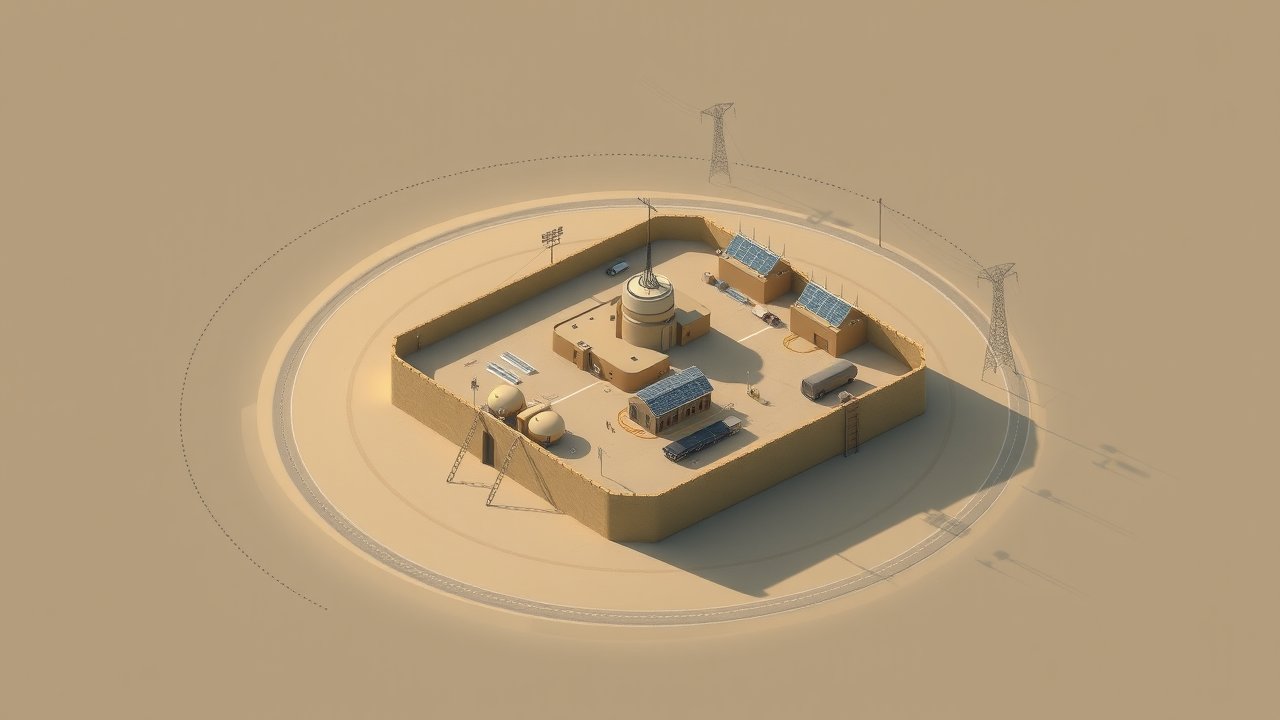
The Pentagon is preparing every major military installation in the continental United States to keep essential operations running for at least 90 days without outside support, according to documents reviewed by Fox News Digital and reported on October 25. The standard covers electricity, water, fuel and communications, and it belongs to FORTRESS America, a program Defense Secretary Pete Hegseth created by memorandum on September 30. The 90-day figure has not appeared in anything the department has published: its public descriptions of the program set no duration, and a senior defense official told reporters on October 20 that the first job was assessing installations and that the department was still working out what the program would cost.
"We don't want to rely on standard civilian municipal infrastructure to run our national defense. We just simply can't. It's an intolerable risk," Sean Parnell, the chief Pentagon spokesman and a senior adviser to Hegseth, told Fox. Fox reported that Parnell led the initiative, and DefenseScoop earlier quoted a U.S. official calling him "the brain child behind FORTRESS becoming a reality." "Power is combat now," Parnell said. "Without electricity, you lose communications, water, logistics, assembly lines and just basic military command structures."
What the program is
FORTRESS stands for Federal Operations for Resilience, Troop Resources, Energy, Supply, and Survivability. Hegseth announced it on September 30 in a "State of the Force" address at Marine Corps Base Quantico, saying "every major military installation in America is going to generate its own power, independent of the civilian grid" and "The Department of War will be the insurance policy for the entire nation." (The administration has used the name Department of War since a September 2025 executive order; the House voted in July to make the change law in its version of the annual defense bill, which has not been enacted.) The program has five pillars: energy independence, supply-chain and defense-industrial-base resilience, a strategic reserve of stockpiles, installation hardening and cyber resilience, and space and spectrum resilience. Michael Duffey, the under secretary for acquisition and sustainment, named Richard "Matt" O'Malley interim director of its program office in an October 6 memo.
Under the documents Fox described, strategic reserves would hold munitions, fuel, critical minerals, electronics, spare parts and medical supplies, sized to how fast stocks are used and how long manufacturers need to replace them. The most critical dependencies would need at least two qualified supply or production routes. An existing program, the Civil Reserve Manufacturing Network, now part of FORTRESS, would identify commercial factories that could switch to defense production in a crisis, with specifications, cybersecurity protections and contracts arranged in advance and tested in recurring industrial exercises.
Power and reactors
On energy, Fox reported that FORTRESS "envisions portable nuclear reactors, large-scale battery storage and microgrids" that would let bases run apart from the civilian grid. "Mission-critical power must be independent, hardened, and redundant," Parnell said. Neither the Fox report nor the department's published program material mentions small modular reactors by name. Reactor work on bases is already under way separately: under the Army's Janus program, Fort Benning, Georgia, is to receive three microreactors from Radiant Industries to power mission-critical facilities during grid outages, with the first operating by 2028.
The reported 90-day standard is far longer than the Army's existing one. Since 2017 the Army has required its installations to be able to supply energy and water to critical missions for a minimum of 14 days.
The threat being planned for
Fox, paraphrasing Parnell, described FORTRESS as an insurance policy for the homeland, and Parnell framed it around a future war: "The next conflict will likely be fought on multiple fronts," he told Fox. "When that happens, global supply chains will break." He said thinking about homeland defense "was built around the antiquated assumption that two oceans would protect us," adding, "You don't want to be making these decisions in the middle of a global multi-front conflict. We have to have a plan." The FORTRESS material reported so far names no adversary. One U.S. government warning about attacks on the civilian systems bases depend on is a February 2024 advisory from the Cybersecurity and Infrastructure Security Agency, the FBI and the National Security Agency, which is part of the Defense Department; the agencies said they "assess with high confidence" that a Chinese state-sponsored group they call Volt Typhoon was positioning itself inside U.S. infrastructure networks to be able to disrupt them. China rejects the attribution: its National Computer Virus Emergency Response Center has called the Volt Typhoon accusation "a political farce written, directed, and acted by the U.S. federal government."
What is not yet known
Much of the program is still in planning. At an October 20 Defense Writers Group roundtable, a senior defense official said the first priority was "doing the assessments of the installations," that officials were weighing the needs of around 500 bases in the continental United States, and that the team was still determining "what is this going to cost." Air & Space Forces Magazine, which reported those remarks, put the likely cost at "scores of billions of dollars, if not hundreds of billions" and said full achievement could take decades. A summary of the founding memo circulated by the government contractor Carahsoft says no immediate budget was allocated, with funding to come in future multi-year defense budgets. Fox's report quoted no one outside the department.
This article reflects reporting through the afternoon of Monday, October 26, 2026. Sources: Fox News, October 25; Air & Space Forces Magazine, October 20; DefenseScoop, October 7; Pentagon News via army.mil; Carahsoft memo summary; U.S. Army on Fort Benning microreactors and the 14-day standard; CISA advisory AA24-038A; The Hacker News.