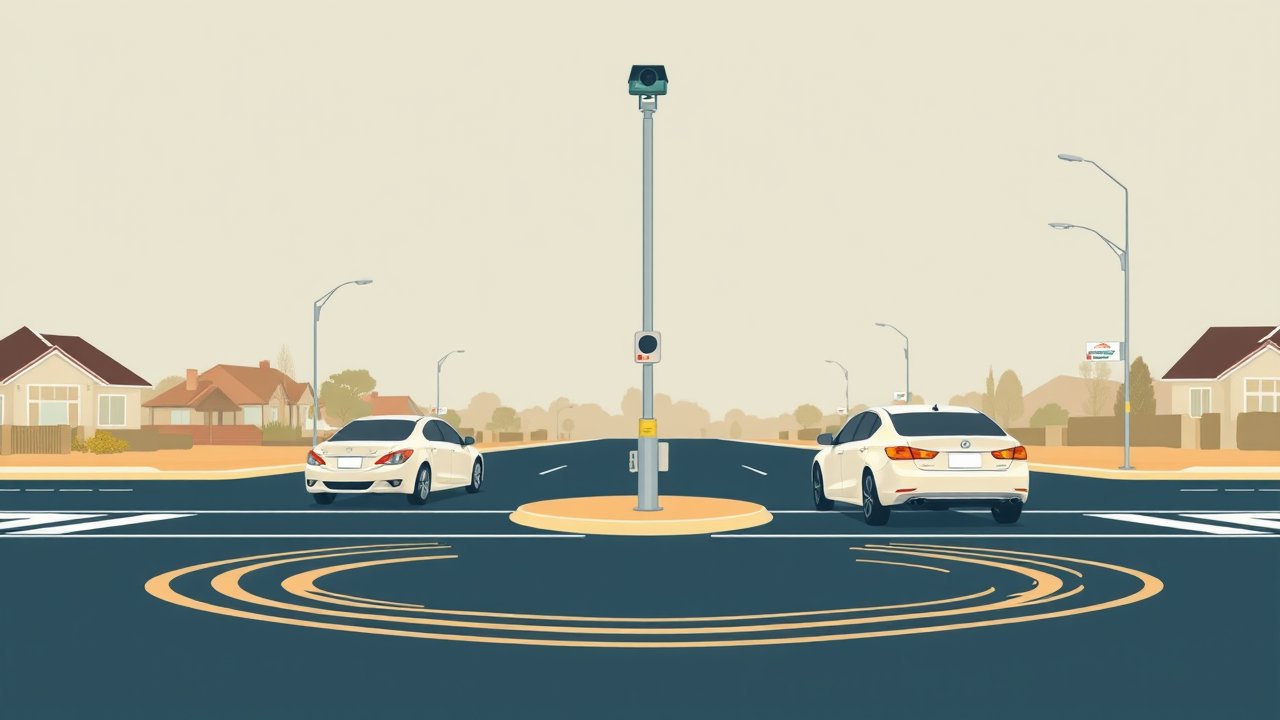
In the space of four days at the end of August, two of the largest states in the country moved against automated licence plate readers. On 28 August, Texas Governor Greg Abbott barred state agencies from spending public money on Flock cameras. On 31 August, the Florida Department of Transportation revoked every permit for the cameras along state highways and gave police 30 days to take them down — a deadline falling on 30 September.
It reads like a turning point. The legal record says something more complicated. In January a federal judge upheld one of these networks against a constitutional challenge, and that ruling joined more than thirty state and federal decisions finding fixed-location plate readers lawful. The political tide and the judicial one are running in opposite directions, and anyone predicting where this lands has to account for both.
What the two states actually did
Both actions are narrower than the coverage suggests, and both limits matter.
Texas restricted state spending. Cities, counties and federally funded agencies remain free to buy and operate the same cameras — and in Texas most of them are run by cities. The order followed reporting by the Texas Tribune that a state body, the Motor Vehicle Crime Prevention Authority, had put at least $30 million into the technology, including a $15.9 million contract in early 2025 covering nearly 1,200 cameras.
Florida revoked permits on state highway rights-of-way only. City streets, county roads, private car parks and residential communities are untouched, and that is roughly 98% of the installed base. Florida has not banned these cameras. It has cleared its own shoulders. The memorandum, signed by transportation chief operating officer Will Watts, cited a sharp rise in deployments together with reports of misuse and data-privacy concerns; if agencies miss the deadline, the department says it will pull the equipment itself.
What happened next was not ordered by anyone. Within days, around 31 Florida counties had gone further than the state required — discontinuing, suspending, or removing cameras from county roads the memo never reached. Sheriffs in Alachua, Baker, Bay, Bradford, Brevard, Charlotte, Calhoun and Pasco counties among others announced they were stopping. That cascade, not the memo, is the larger development.
It is also not confined to Florida. The Institute for Justice, which maintains a running database of cancellations, counted 163 local governments that had cancelled or declined licence plate reader contracts as of 3 September. The trajectory is steeper than the total: 92 on 26 August, 137 by the 28th, 144 by the 31st, 163 within a fortnight. The count is conservative by construction — it excludes jurisdictions that merely paused operations or switched to a rival vendor.
The case that gave the movement its evidence
On 20 August, an Angelina County grand jury indicted Lufkin police officer Zachary Anthony Klein, 32, an eleven-year veteran of the department, on 100 felony counts of misuse of official information, accusing him of tracking eleven private citizens for non-governmental purposes.
The specifics are what make it land. An arrest affidavit alleges he used the plate reader system more than 10,000 times to follow a former partner, her relatives, and people she had relationships with. Department records reportedly show 45,318 searches across 210 days — roughly 74 a day, every day, for seven months — with a single plate queried about 3,470 times in a year. He was booked with bail set at $700,000. A second officer was placed on administrative leave and the department suspended its use of the system entirely. Klein has been charged, not convicted, and is entitled to the presumption of innocence.
Flock Safety's answer is that this is misuse rather than design, and that misuse is detectable: chief executive Garrett Langley has described an audit tool that flags abnormal search patterns for review. Police defenders make a related argument — that the overwhelming majority of officers use the system to investigate crime — and there is a fair point buried in the case itself, which is that the same detailed logging that enabled the alleged abuse is what produced the evidence supporting a hundred felony counts. The counter from critics is equally direct: the searches ran for seven months before anyone acted on them.
What the technology is actually for
The case in favour is not hypothetical. Flock says its systems supported roughly a million law enforcement investigations last year and helped locate more than 10,000 missing people. Independent research is more qualified. One evaluation found that expanding plate reader coverage was not associated with reductions in violent crime, but was associated with reductions in shootings, vehicle thefts and property crime — a real effect, on a narrower set of offences than the marketing implies.
The scale figures cut both ways, and the clearest example is San Jose. Its 474 cameras recorded more than 360 million images in 2024. About 0.25% matched a police hotlist — the lists covering stolen vehicles, outstanding warrants, criminal suspects and missing persons. Read one way, that is an inexpensive net that catches serious crime. Read the other, it is a city's movements collected 400 times over for every one time it produced a hit.
The legal fight, which the challengers are currently losing
The objection that plate readers do something different from an ordinary camera has a name in Fourth Amendment law: the mosaic theory. The argument is that observations which are individually trivial can, aggregated across months, reveal something the Constitution protects — where a person sleeps, who they visit, which clinic, which church, which lawyer. A single photograph of a car on a public road tells you almost nothing. Four hundred and seventy-five photographs of the same car over four and a half months tell you how someone lives.
That figure is not hypothetical either. It is what Norfolk's 176-camera network captured of one plaintiff in Schmidt v. City of Norfolk, the Institute for Justice's challenge on behalf of two residents. On 27 January 2026 the district court granted judgment for the city, holding there had been no search at all: the network does not track continuously, it has gaps, and it records only what is visible from a public road.
The case is now on appeal at the Fourth Circuit, and the plaintiffs arrive in better shape than the loss suggests. On 29 June 2026 the Supreme Court decided Chatrie v. United States, holding that a geofence warrant seeking location history is a Fourth Amendment search — extending its 2018 decision in Carpenter v. United States and rejecting the argument that extracting one slice from an enormous database is not a search. And in 2021 the Fourth Circuit itself, sitting en banc, struck down Baltimore's aerial surveillance programme, comparing continuous city-wide observation to fitting every resident with an ankle monitor. The appeal therefore reaches the one circuit that has already accepted the theory once.
The weight on the other side is substantial. The Justice Department filed in support of Norfolk, as did sixteen states and the District of Columbia. Cato, the Electronic Privacy Information Center, the ACLU, the Electronic Frontier Foundation and the New Civil Liberties Alliance filed for the residents. Nobody involved is treating the question as settled.
What is not yet known
Whether Florida's 30 September deadline holds. Whether the Texas restriction survives contact with city budgets and federal grant money. Whether the Fourth Circuit reads Chatrie as broadly as the challengers need it to. And whether clearing cameras from public roads changes much while the privately owned ones — at shopping centres, gated communities and apartment complexes — keep running, outside the reach of any of these orders.