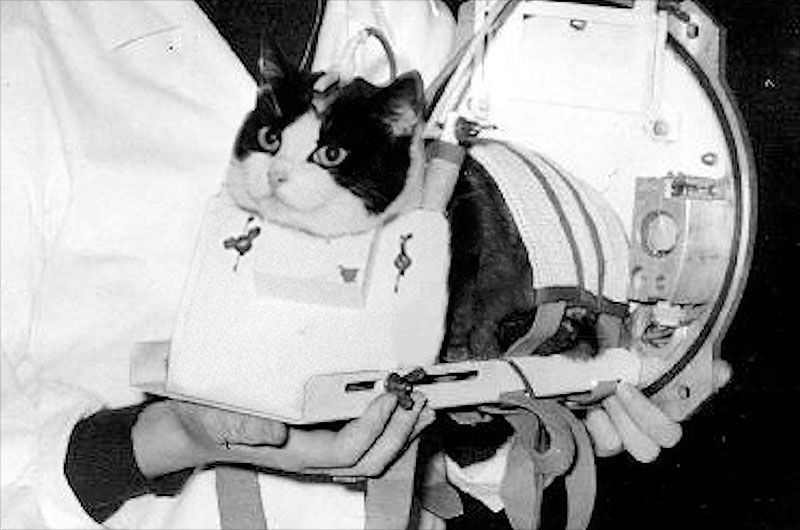
How did the USSR win the space race to beat the US to the moon in Apple TV's new 'Star City'?
"I take this step for my country, for my people, and for the Marxist-Leninist way of life."
Research, Space & Discovery
"I take this step for my country, for my people, and for the Marxist-Leninist way of life."
During the development of marine organisms—from fertilization through to juvenile stages—it is often observed that the eggs released into the water column are initially supplied with only a small frac...
Researchers have developed a powerful new tool that can track how microbes spread between people with unprecedented precision, offering new ways to prevent infections and improve treatments in the fut...
Measuring the strength of gravity is extraordinarily difficult, and different experiments have always disagreed – but a new test is paving the way to finally understanding nature’s most enigmatic forc...
One of the biggest challenges in cancer research is understanding why some tumor cells become especially aggressive, invasive and resistant to treatment. Scientists have increasingly linked these dang...
Comet PanSTARRS recently survived its close brush with the sun.
As the U.S. economy becomes more consolidated, the strategic decisions of senior leaders at leading companies carry ever-greater weight. A lot is riding on how these companies are run, yet in most cas...
A team of astrophysicists from Nanjing University and University of Bonn have demonstrated that, rather than being random, the mass of new stars born inside a star cluster is actually governed by a de...
Carbon nanotubes are one technology that many observers believe hasn't quite lived up to the extreme hype that surrounded them when they first appeared on the scene in the late 1990s. At that time, mu...
A research team has developed a high-efficiency electrochemical system that simultaneously produces hydrogen and value-added chemicals using glycerol, a low-cost, abundant byproduct of biodiesel produ...
For observers on Earth, the sun appears as a bright, familiar disk—but what we see is only half the story. Like the moon, one half of the sun is permanently hidden from our direct view: the far side b...
Imagine your favorite sunny beach. Anywhere will do. You look out and see the ocean stretching to the horizon. To a glaciologist, that view is not just water; it's melted ice. Our new study shows that...
Samples of Ryugu returned to Earth by the Hayabusa2 spacecraft show that the asteroid bears the scars of a recent bombardment by tiny space rocks.
Messier 104, nicknamed the Sombrero Galaxy, is a popular target for amateur observing and astronomical research. Its recognizable extended halo, as well as a faint stellar stream, are captured in exqu...
The Large High Altitude Air Shower Observatory (LHAASO) has detected PeV (1015 eV) gamma-ray emission from a pulsar wind nebula powered by PSR J1849-0001 in the constellation Aquila, marking the disco...
Listen to this audio excerpt from Peter Rossoni, Orion Artemis II Optical Communications System flight manager: As a child, Peter Rossoni watched the Apollo missions launch with his family. In April 2...
Using the Large Sky Area Multi-Object Fiber Spectroscopic Telescope (LAMOST), astronomers have observed a nearby young open cluster known as NGC 1647. Results of the new observations, presented in a p...
A study by University of Wollongong (UOW) physicist Dr. Enbang Li has demonstrated that gravity can subtly influence the behavior of light, a breakthrough that could underpin future technologies for m...
A week after the Artemis 2 moon mission ended, NASA astronaut Christina Koch struggled to walk in a straight line during a blindfold test. But it's all part of readjusting to life on Earth.
An international team of academics led by Professor Garrick Allen at the University of Glasgow has successfully recovered 42 lost pages from one of the world's most important early New Testament manus...