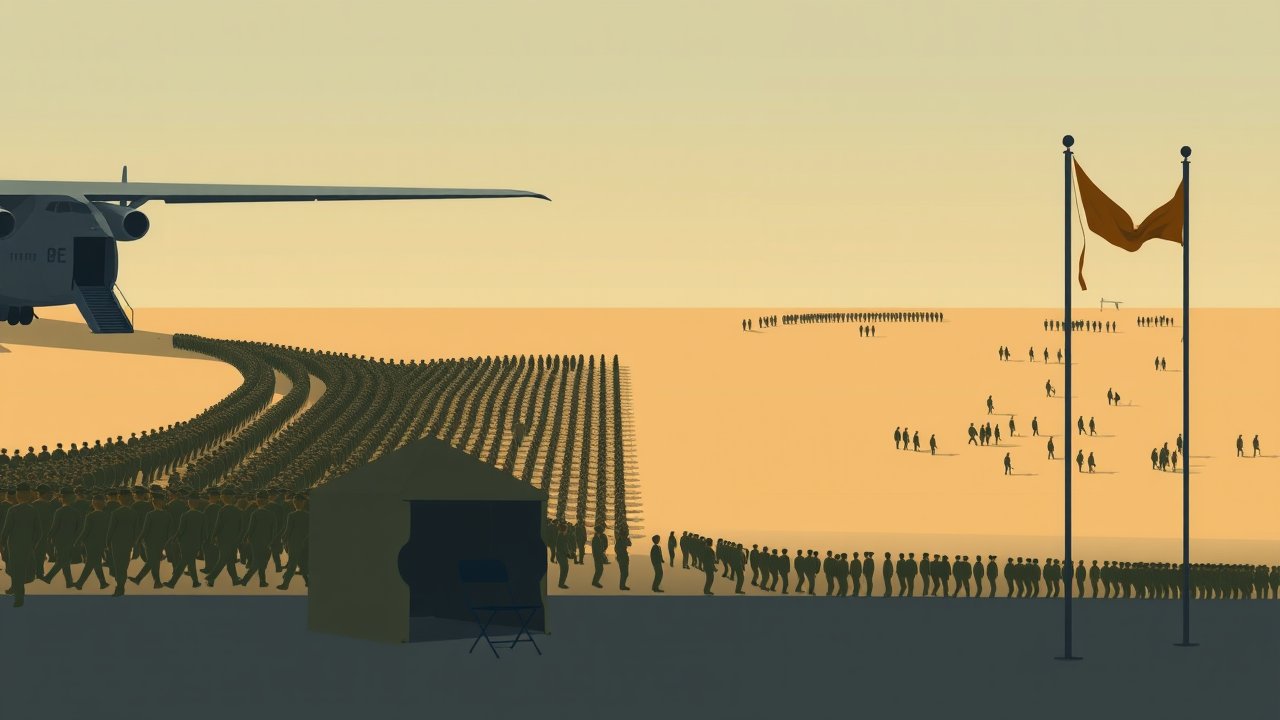
El Salvador says it is putting more than 2,000 soldiers into Haiti, and President Nayib Bukele said on Thursday evening, October 29, that the deployment was "nearly completed." The figure is El Salvador's own: its Foreign Ministry said on October 28 that the country "will continue with the operational deployment of more than two thousand soldiers to rescue the four Salvadoran aviation technicians" (Profoundd's translation), air force members missing since an October 18 gang ambush outside Port-au-Prince. An unnamed security official told Reuters that around 2,000 were in Haiti as of Wednesday night, and two sources told the agency the number would be capped for now at 2,500; official sources cited by Haitian media had put the count at about 1,300 on Wednesday, the news agency EFE reported, and none of the outlets Profoundd read reported an independent headcount.
Reuters summarized the ministry's statement as saying the soldiers would rescue missing personnel and support anti-gang security operations; the statement itself, as EFE quoted it, said Bukele "reaffirmed El Salvador's willingness to continue supporting security work against the gangs" in Haiti (Profoundd's translation). Reuters added that "authorities have not clarified the troops' command, or rules of engagement," and that the force's size had raised the question of a broader, longer operation. CNN reported that "local sources say it is unlikely that the missing four can be recovered"; Bukele told reporters on Thursday that "our objective is to rescue them alive," El Colombiano reported (Profoundd's translation).
"Not an invasion," and "a lesson" for the gangs
Bukele's statement was a post on X in Haitian Creole addressed to the "People of Haiti." "This is neither an operation directed against the Haitian people nor an invasion of Haiti," he wrote, in HaitiLibre's English translation. "Our sole objective is the safe return of our four aeronautical technicians. Furthermore, we intend to teach a lesson to these gangs." At a press conference the same day he said the operation was not a general offensive but that his forces would act against gangs that obstructed the rescue, elsalvador.com reported. "If they don't hand them over willingly, well, we'll rescue them by force," Bukele said, in Democracy Now's translation; "if they hand over the four aviation technicians tomorrow, we leave tomorrow afternoon" (Profoundd's translation of elsalvador.com's report). Reuters wrote that "Haitian and Salvadoran authorities have said the troops' main mission is to rescue the missing technicians." Romain Le Cour of the Global Initiative Against Transnational Organized Crime said the troops' rules of engagement, chain of command, objectives and duration "remain opaque," in remarks reported by the Associated Press.
Inside the UN-backed force, or beside it
El Salvador already contributes to the Gang Suppression Force, the UN Security Council-authorized mission. CNN put the new contingent at "about equal to the current staffing" of that force, whose own size is reported as anywhere from more than 1,000 soldiers (EFE) to 2,526 before the Salvadoran surge (the Miami Herald). Whether the new troops answer to the force is unresolved. CNN reported that "the Salvadoran forces' command structure has not been established, according to a source close to the matter," and that "the Salvadorans were not staying at the main GSF base in Port-au-Prince"; sources told the Herald the troops were at a camp near the U.S. Embassy and that even senior Salvadoran officials in Haiti had "been left in the dark about their orders." EFE described the deployment as proceeding "al margen del mandato," outside the mandate the Security Council set for the force in September 2025.
Haitian officials describe the operation as cooperation. The office of Prime Minister Alix Didier Fils-Aimé, confirming a Wednesday phone call with Bukele, said the two leaders "reaffirmed their engagement to reinforce bilateral coordination and operational co-operation in the framework of the (UN-backed) Gang Suppression Force," Reuters reported; the office "did not immediately respond" when Reuters asked whether that meant the troops would join the force or operate separately. A Haitian government source told Le Nouvelliste, Haiti's oldest newspaper, that "this deployment is being carried out in communication with the Haitian government. It is a friendly country that is helping. It is not an invasion of the country," and, on the secrecy surrounding it, that "the government prefers to keep quiet and act," EFE reported (Profoundd's translation). As of 18:55 UTC on Friday, the prime minister's office had posted nothing further on the deployment on X or on its website's home page, whose press-release page returned an error, Profoundd found.
Several sources told the Miami Herald that El Salvador had not signed a required status-of-forces agreement with Haiti, the accord that sets the legal terms for foreign troops on a host country's soil, when its reinforcements began arriving, and the paper reported that most of the Salvadorans had not had the Gang Suppression Force's two weeks of in-country human rights training. Bukele told reporters on Thursday that "we have authorization from all international and national levels," El Colombiano reported (Profoundd's translation); Prensa Latina, Cuba's state news agency, noted that he did not specify the international ones. Jean Dorneval, a former Haitian defense minister, told the Herald: "The population sees it as a good thing, but we do need to know under what framework they've arrived."
Reuters reported that security analysts in El Salvador "said they were cautious of a risky mission without a formal agreement, UN backing, or support from the Shield of the Americas," the U.S.-led anti-crime coalition launched this year. Barnabas Dieudonné, a Haitian jurist, told EFE that "in principle, the consent of Haiti, which is a sovereign state, is required," and in the same interview that "Haiti would have no reason to oppose" an operation against groups its authorities say they want expelled (Profoundd's translation).
On the Salvadoran side, the Special Transitional Law for the Participation of El Salvador's Armed Forces in the Gang Suppression Force (GSF) in Haiti, which the Legislative Assembly passed on September 29 and which took effect on October 2 after publication in the official gazette, authorizes participation in that force for twelve more months. Diario El Mundo reported that, unlike the 2024 decree limiting the contingent to medical evacuations, it allows "civilian and military personnel according to the needs of the mission" (Profoundd's translation), and the passages the paper quoted name no troop number. Profoundd could not find the full text on the Assembly's website or in a web search on Friday to check whether the law covers troops operating outside the force's mandate, as EFE describes these; Haiti's prime minister's office places the cooperation within the force.
Who flew them in
The Miami Herald reported that one of four aircraft that landed 350 Salvadoran soldiers on Friday, October 23, was a U.S. C-130 "provided by the Pentagon at the request of the U.S. State Department"; a U.S. Southern Command spokesperson told the paper, "U.S. Southern Command confirms that a U.S. military aircraft providing logistical support arrived in Port-au-Prince." Reuters wrote that "Washington has not publicly supported the mission but a US military official said Pentagon C-130s helped it deploy."
HaitiLibre reported, citing flight trackers and Salvadoran press, a Colombian Air Force C-130H flight from San Salvador to Port-au-Prince on October 27 with personnel and equipment, and the Herald wrote on October 29 that "Colombia has pitched in with the chartered airlifts." The Colombian newspaper El Colombiano reported on Friday that neither the Colombian Air Force nor the Colombian government had confirmed or denied taking part, and none of the 94 posts and reposts on the air force's X account from October 7 to Friday morning mentioned Haiti or El Salvador, Profoundd found. El Salvador's Foreign Ministry described "a large-scale operation backed by various countries and international organizations" without naming them in the passages EFE and elsalvador.com published (Profoundd's translation); Bukele wrote of "limited logistical support from a few other nations" and said El Salvador was paying "90% of the expenses."
The four men
As of Friday afternoon, no authority had identified the four technicians or any remains as theirs. Profoundd reported on October 25 that Bukele had rejected a New York Times report that four bodies believed to be the men had been found near the capital, writing "They are not our men," and that the identities of the remains had not been independently confirmed. The Gang Suppression Force said on X on October 25 that it had received, "through a third-party humanitarian organization, remains suspected of being those of the four personnel," and that "at this stage, the GSF is not in a position to confirm that the remains are those of the missing personnel"; none of its later posts, through Friday afternoon, reported an identification. Nothing in HaitiLibre's October 29 and 30 roundups, La Prensa Gráfica's running log (last entry October 27) or Friday's Salvadoran press reports a change. Wilson Joseph, the 400 Mawozo gang leader, claimed in a video reported by HaitiLibre on October 27 that the men died by mistake in clashes; no authority has confirmed that.
At home: 86 percent approve; critics ask who is accountable
A CID Gallup telephone poll of 600 Salvadoran adults, October 24 to 27, found 86 percent agreed with the operation, 82 percent were worried about the safety of those deployed and 94 percent approved of Bukele, with a four-point margin of error, Diario El Mundo reported; CID Gallup's own post on X gave the 94 and 82 percent figures, and Profoundd could not retrieve the full poll from the pollster's website. Sandra Pellegrini, Latin America lead at the Armed Conflict Location and Event Data Project, told La Prensa Gráfica that given "El Salvador's human rights record," security work "outside the existing mechanisms" and alongside private actors "could aggravate the risks for the civilian population" (Profoundd's translation). Bukele, comparing Haiti's gangs with El Salvador's at his press conference, said: "We know how to deal with criminals of that kind" (Profoundd's translation). Profoundd found no statement on the deployment from Cristosal, the Salvadoran human rights group, in searches in Spanish and English on Friday or on its website and X account.
For many Haitians, the troops' arrival "means a chance to finally see decisive action on gangs," the Herald reported; "We think he can be a model for us," Bertide Horace, an activist in the Lower Artibonite, told the paper. Bill O'Neill, the UN's human rights expert for Haiti, said in remarks CNN reported: "The situation is volatile and could become more violent with innocent people being harmed." Le Cour's summary, as CNN quoted it: "As long as no one can say who decides and who is accountable, every operation risks adding to the confusion rather than to security." Bukele's, to Haitians: "Perhaps future generations of Haitians will remember us as friends who once came to offer their help."
This article reflects reporting through the afternoon of Friday, October 30, 2026. Sources: President Nayib Bukele's post on X, October 29, and HaitiLibre's English translation; HaitiLibre, October 29, and October 27; Reuters via Internazionale and CP24, October 29; CNN, October 29; the Associated Press via WRAL; La Prensa Gráfica, October 29 and October 28; EFE via La Prensa Gráfica, October 29, October 28 and the Dieudonné interview; elsalvador.com and Democracy Now, October 30; Diario El Mundo on the CID Gallup poll and the September 29 law (passage, entry into force); the Miami Herald, October 29, and via AviationPros; the Gang Suppression Force's post on X, October 25; Le Nouvelliste; El Colombiano via Yahoo Noticias and Prensa Latina, October 30; CID Gallup's post on X; and Profoundd's October 25 report. Spanish- and French-language sources were read in the original and Bukele's post in Haitian Creole; translations not otherwise credited are Profoundd's.