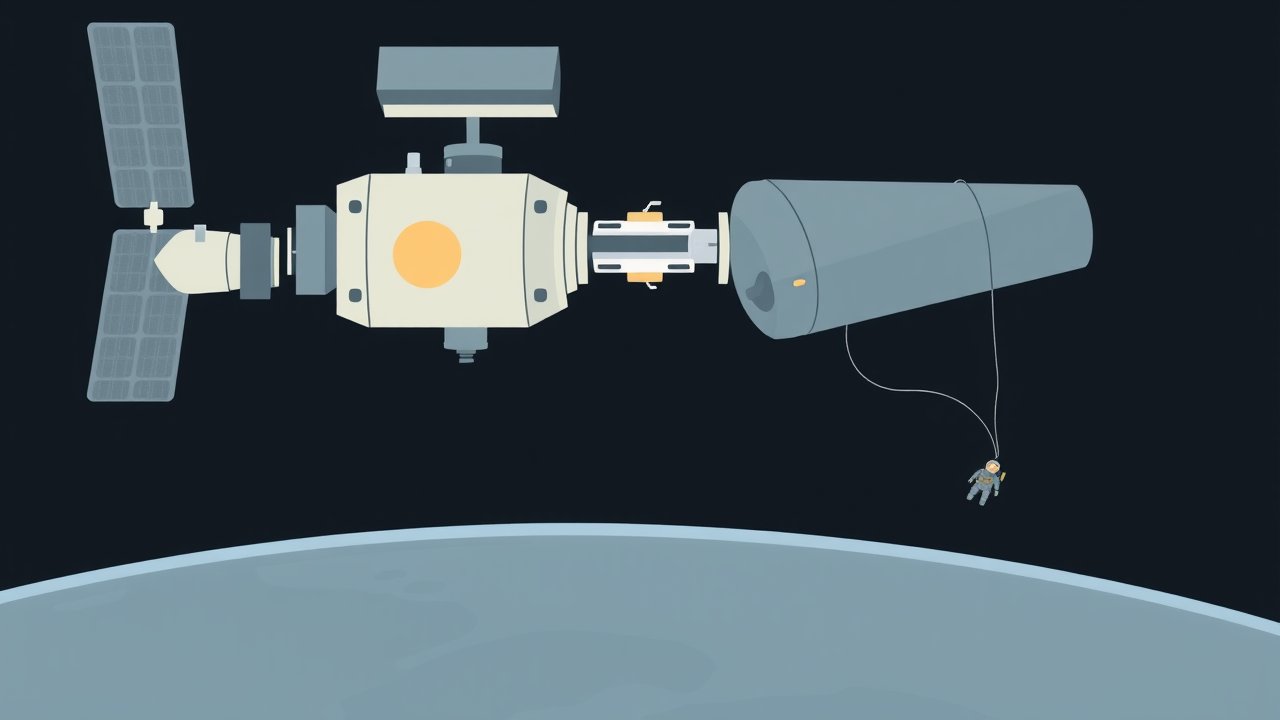
Five of the seven astronauts currently aboard the International Space Station were directed to take refuge inside a docked SpaceX Dragon capsule Thursday after Roscosmos detected an air leak in the Zvezda service module's transfer tunnel, known as the PrK. NASA ordered the shelter-in-place as a precautionary measure, designating the Dragon as a safe haven while two Russian cosmonauts stayed behind to attempt a fix, according to reporting by the BBC and confirmed by NASA spokesperson Bethany Stevens via social media.
The leak originated from cracks in the PrK transfer tunnel — a section of the station with a documented history of structural degradation. This is not a new emergency. The same tunnel has been producing sporadic leaks for roughly six years, with crews applying stopgap patches that were never intended as permanent solutions. NASA has acknowledged monitoring the cracks closely, and Roscosmos has made incremental mitigation efforts over that period. What Thursday's incident makes plain is that those efforts have a ceiling.
The repair attempt was put on hold before completion. Stevens stated that cosmonauts paused work "as more measurements and data is assessed," and that NASA looks forward to a "collaborative approach" with Roscosmos going forward. No timeline for a resumed or more comprehensive repair operation has been announced. That language — collaborative, forward-looking, data-pending — signals that no immediate fix is on the table.
The broader context matters here. The ISS is an aging structure, with the oldest modules now more than two decades in orbit. The Zvezda module, built and operated by Russia, has been a recurring point of concern in the U.S.-Russia partnership that keeps the station functional. Structural fatigue in the PrK tunnel was first publicly flagged around 2020, and successive patch jobs have bought time rather than solved the underlying problem. NASA's own posture has been to watch closely while deferring to Roscosmos on Russian-segment repairs — a division of responsibility that is now visibly under strain.
What comes next, according to the available reporting, is likely a more extensive repair mission designed to address the cracks permanently rather than plug them temporarily. When that mission happens, who conducts it, and whether the station can continue normal operations in the interim are questions NASA has not yet answered publicly. For now, the Dragon capsule — originally docked as a crew transport — has earned a secondary role as the station's emergency lifeboat, a function it was designed to serve but one no one wants to rely on.