Updated Nov. 12, 2026: We now say this is Japan's stated aim. We added residents' fears and cut the story.
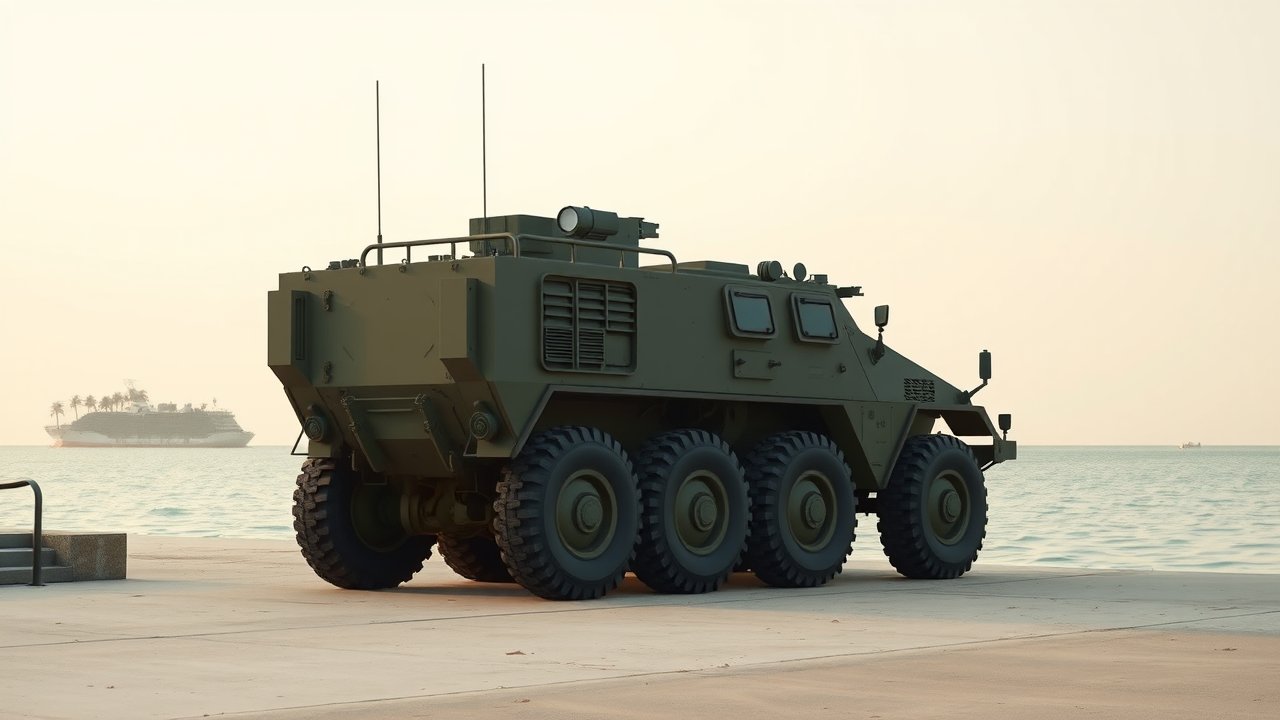
Japan's army, the Ground Self-Defense Force, moved its first two Type 16 combat vehicles to its base in Naha, Okinawa, on Nov. 5. They are the first based in Japan's southwest islands, the Yomiuri newspaper reported. Each has a 105 mm gun.
By March 2027, the Naha brigade will become a division, a larger unit. It will grow from 2,300 troops to about 3,900, the Yomiuri reported. It will also lead the units on Miyako and Ishigaki, islands closer to Taiwan. It follows a 2022 plan, made law in June.
Tokyo's reasons
The buildup is meant to counter China's growing military moves, The Japan Times reported. The Yomiuri cited worry over Taiwan. On Nov. 2, Japan's military said, it sent up jets as two Chinese drones flew between Okinawa and Miyako. Defense Minister Shinjiro Koizumi said the new unit lets Japan act fast in the southwest. Most big army units already have the vehicles, he said. Okinawa's brigade was the smallest in Japan, a defense writer wrote. Its scouts' only armed vehicle was a scout car.
The Okinawa Times asked why the rush. Okinawa has no range where the vehicles can fire, it wrote. Firing drills will be held on Japan's main islands. It asked if basing them there, and flying them in when needed, would be better for readiness and cost.
The governor
Gov. Genta Koja, a conservative, won in September. On Nov. 6, he said Okinawa was "briefed" under the last governor. The move seems to follow "that plan," he said. The Ryukyu Shimpo asked if the last governor got details on timing and size, or a say. On Nov. 9, speaking of the buildup as a whole, Koja said he will press Tokyo to explain the "minimum necessary" defense. He wants to know why each role and site is needed.
The ministry had planned to brief Koja in mid-November, the Ryukyu Shimpo wrote. The vehicles came first. The paper asked if that was forcing done deals on Okinawa. Koizumi said Okinawa and Naha were told of the plan, vehicles included, in December 2025. He said arrival dates stay secret for safety. On Nov. 10, he said no date was set to brief Koja.
Risk of war
Peace groups rallied on Nov. 6 against the vehicles and against U.S. Osprey aircraft, which Koja accepted. "This deployment is premised on fighting a ground war in Okinawa," said Takamatsu Gushiken, a group leader, on Nov. 5. The ministry says the vehicles will deter an enemy landing, the Okinawa Times reported. Koizumi calls island defense "essential to protect Japan and the people of Okinawa." Some residents fear the islands could become a target, The Japan Times reported.
Communist lawmaker Taku Yamazoe, whose party voted no, said the law follows U.S. military strategy and stirs up tension. It raises "the danger of war," he said. Koizumi says Japan is rebuilding its defenses to keep the peace and "never let a new war start."
China
China's foreign ministry did not name the vehicles or Okinawa in its Nov. 5-12 briefings, Profoundd found. In November 2025, a spokeswoman said Japan was putting "offensive weapons" on islands near Taiwan. She tied it to Prime Minister Sanae Takaichi's remarks on Taiwan and called it "extremely dangerous." Koizumi had said planned air-defense missiles on Yonaguni island would lower the risk of an attack on Japan.
On Nov. 5, asked about Japan's new security plans, spokesman Guo Jiakun said Japan was building "offensive" forces. He said it keeps breaking its "defense-only" rule. Its ambition to speed up "remilitarization" is "plain to see," he said. Japan's top spokesman, Minoru Kihara, said in May that China's charge of "new militarism" was "completely off the mark." He said Japan's defense-only policy has not changed.
Reporting through Thursday, November 12, 2026. Quotes from Japanese and Chinese are Profoundd's translations. Sources: Japan Defense Ministry news conferences, Nov. 6 and Nov. 10, 2026; Defense Buildup Program, Dec. 16, 2022; Yomiuri Shimbun, Nov. 2 and Nov. 7, 2026; Ryukyu Shimpo, Nov. 6 and editorial, Nov. 7, 2026; Okinawa Times editorial, Nov. 6, 2026; The Japan Times, Nov. 9 and Sept. 24, 2026; Trafficnews, March 28, 2026; Army Recognition, on Japan's Joint Staff report of Nov. 2, 2026; Kyodo and Akahata, June 26, 2026; China Foreign Ministry briefings, Nov. 24, 2025, Nov. 5, 2026 and Nov. 6-12, 2026; Bloomberg, May 25, 2026.