A claim that circulates periodically online holds that President Trump appeared at the Cheyenne Mountain complex in Colorado around 13 March 2020 and told those present that the United States was already at war — and that this signalled some form of continuity-of-government arrangement being activated. We went looking for the record behind it. What we found is that two consequential things really did happen that month, eleven days apart, both thoroughly documented, and neither one is the event described.
13 March 2020: a national emergency, in the Federal Register
On 13 March 2020 the President signed Proclamation 9994, declaring a national emergency concerning the COVID-19 outbreak. This is not disputed and not obscure: it was published in the Federal Register on 18 March 2020 at volume 85, number 53, pages 15337 to 15338, under document number 2020-05794. It also appears in the government's own compilation of presidential documents and in the Statutes at Large. Anyone can pull it up and read it.
A national emergency declaration under the National Emergencies Act unlocks a defined set of statutory authorities that Congress has written into law over decades — spending flexibilities, waivers, procurement powers. It is a significant instrument. It is also an entirely public one, filed and numbered like any other presidential document.
24 March 2020: NORAD really did go into the mountain
Eleven days later, something happened that sounds much more like the claim, because in one respect it is. General Terrence O'Shaughnessy, then commander of both U.S. Northern Command and the North American Aerospace Defense Command, announced during a virtual town hall on 24 March 2020 that his command-and-control watch teams had been split up and dispersed into hardened facilities.
Part of the watch team moved into Cheyenne Mountain Air Force Station. Part remained at Peterson Air Force Base. A third team went to an alternate location that was not disclosed. O'Shaughnessy said the personnel involved had "left their homes, said goodbye to their families, and are isolated from everyone" so that they could keep standing watch. Ballistic missile defence crews were placed in full isolation as well.
The reason given was the pandemic, not a war. The point of dispersing a watch team across three hardened sites is that a respiratory virus moving through one crew cannot take out the homeland defence mission, because two other crews are physically separated from it. The move was announced publicly, by a named four-star officer, on the record, and covered at the time by defence trade press and general news outlets alike.
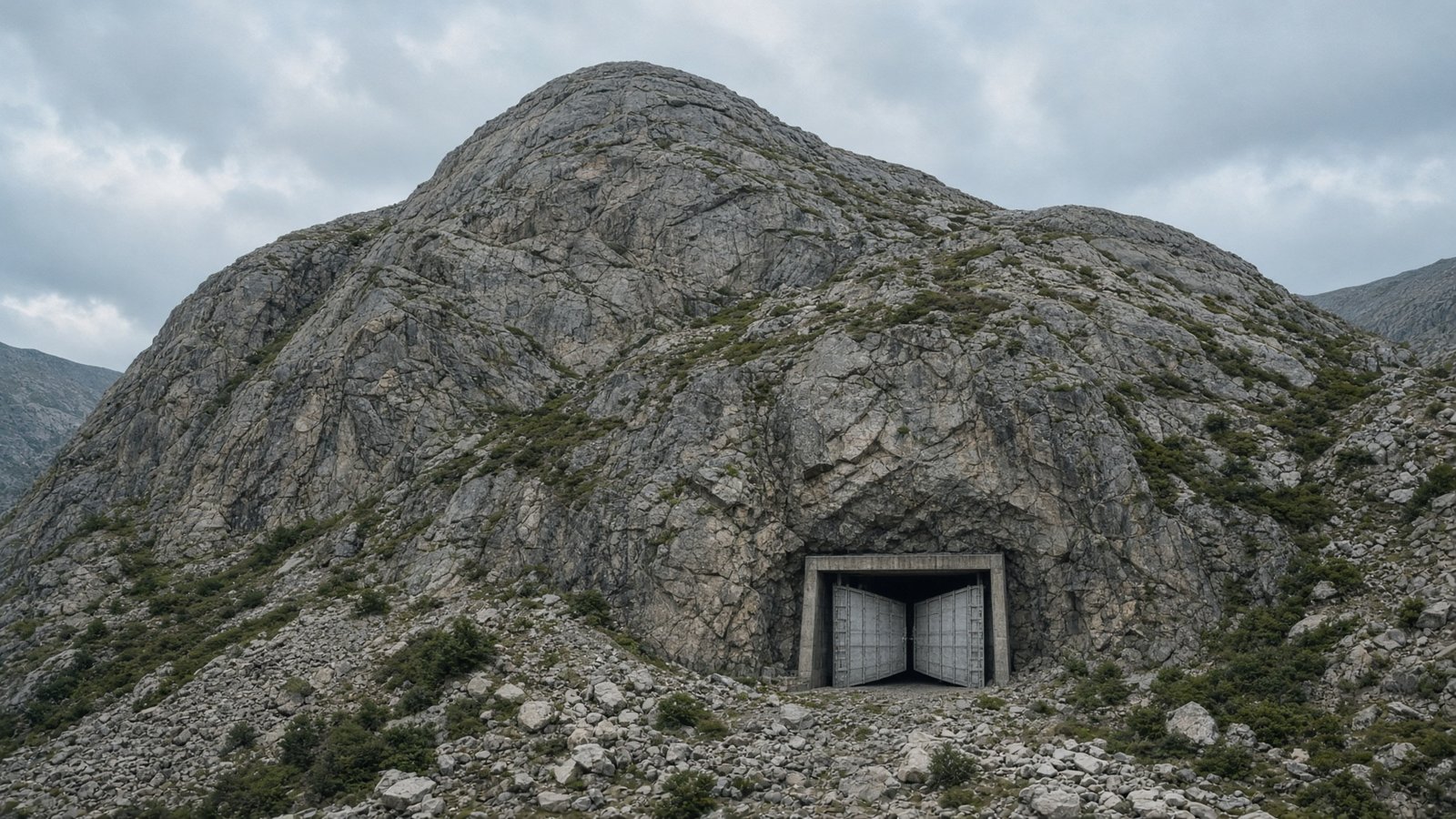
Cheyenne Mountain lends itself to the imagery. It is a complex of tunnels under roughly 2,000 feet of granite behind blast doors, and it served as NORAD's primary command centre from 1965 to 2006. A military command moving into it is genuinely dramatic. It is also, on this occasion, documented as an infection-control measure.
What we could not find
We found no record of President Trump visiting Cheyenne Mountain — no White House schedule entry, no press pool report, no transcript, no news coverage. We found no record of him saying the United States was "already at war" there or in connection with that facility.
That finding deserves to be stated carefully, because a failed search and a disproven claim are not the same thing, and treating them as the same is how a lot of bad reporting happens in both directions. We are reporting that we did not find it. What gives the absence some weight is the nature of the thing: a sitting president travelling to a military installation generates an unusually heavy paper trail — advance logistics, a travelling press pool, a schedule entry, local coverage, base public affairs. Presidential movements are among the most documented events in American public life. An undocumented one is not impossible, but it would be unusual.
Claims placing Trump at Cheyenne Mountain are not new, either. At least one earlier and unrelated version — involving a laptop said to have been taken from the Speaker's office — was circulated widely enough to draw a published fact-check in 2021. We could not read that fact-check's conclusion, as the page is behind a paywall, so we note only that the claim existed and was examined, not what the examination found.
Why two real events become one unreal one
The ingredients are all genuine. There was a national emergency declared in the middle of March 2020. A military command really did move into a nuclear bunker later the same month. Both were unprecedented in the experience of most people alive to see them, and they happened close enough together to feel like one story.
What is added, rather than found, is the connection between them and the words attributed to the President. The emergency proclamation is a public document about a virus. The Cheyenne Mountain dispersal was announced by a commander who explained it as protecting a watch crew from that same virus. Neither document nor announcement says what the claim says.
None of this settles the broader arguments about emergency powers, continuity-of-government planning, or what those arrangements permit — those are real subjects with real documents attached, and worth reporting separately and carefully. It settles one narrow question: whether the specific Cheyenne Mountain episode happened as described. On the available record, it did not.
How we checked
Every factual claim above traces to a primary document or a named official speaking on the record: the proclamation as filed in the Federal Register, and General O'Shaughnessy's own announcement as reported at the time with direct quotation. We deliberately did not rely on our own automated research pass for this piece — it returned three usable items from twenty-six pages and confused a novel about a fictional nuclear scenario with real NORAD operations. When a search comes back that thin, the honest conclusion is that the search failed, not that the world is empty.