Japanese scientist Shirakawa, co-winner of 2000 Nobel Prize in chemistry, dies at 90
Japanese scientist Hideki Shirakawa, co-winner of the 2000 Nobel Prize in chemistry for discovering and developing conductive polymers, has died. He was 90.
Research, Space & Discovery
Japanese scientist Hideki Shirakawa, co-winner of the 2000 Nobel Prize in chemistry for discovering and developing conductive polymers, has died. He was 90.
Scorching conditions this year have triggered wildfires in European countries that are normally considered to be damp and cool
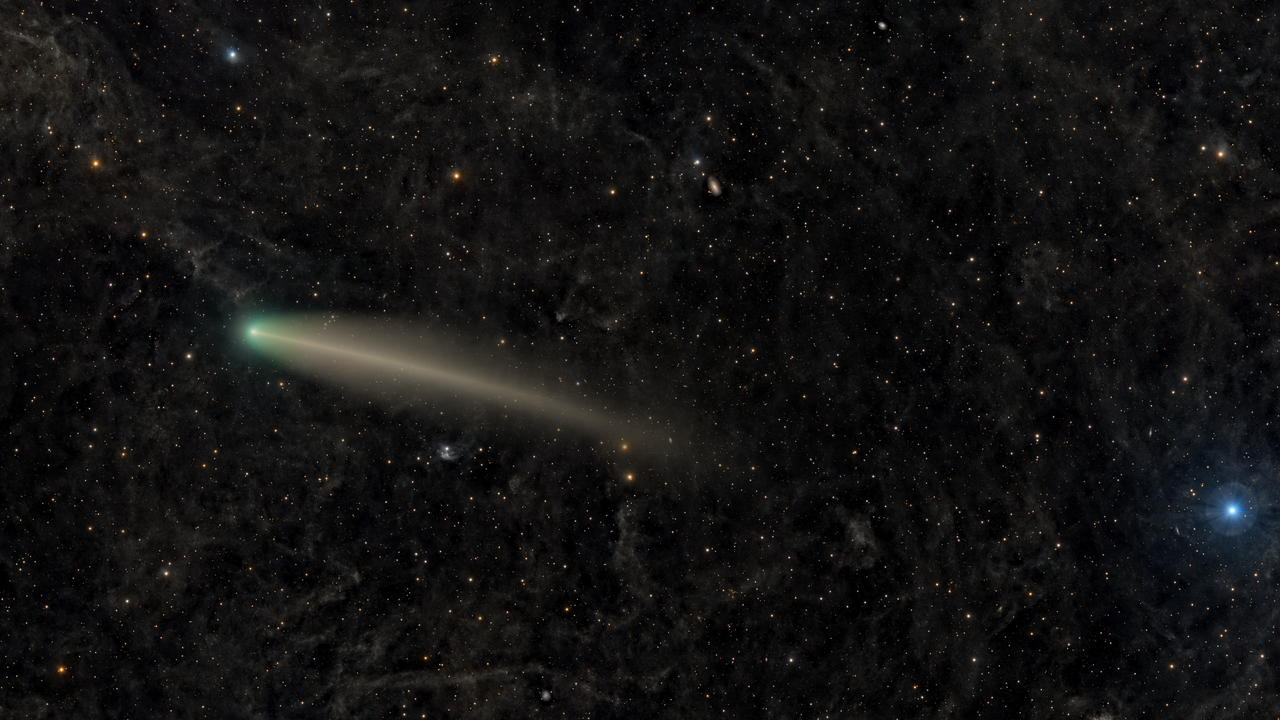
Comet McNaught brightened dramatically during two outbursts around perihelion as it made a close approach to the sun.
Majority voting may make us less willing to tolerate advantages for othersThe postEnvy at the Ballot Boxappeared first onNautilus.
Written by Michelle Minitti, MAHLI Deputy Principal Investigator Earth planning date: Friday, Aug. 21, 2026 After Curiosity’s 14 years on the surface, Mars continues to surprise. Both of our workspace...
An active childhood may train the growing body to make movement less demanding for life. A Penn State-led experiment found that birds raised while carrying extra weight became remarkably economical wa...
Florida Puts Millions Behind Ivermectin Cancer Research—But Funding Is Not Proof of a Cure
Research means asking questions of the universe. For centuries, clever minds have advanced science by devising ingenious experiments designed so their results reveal something about the laws of nature...
A new study finds that as people age, they remember fewer details from their past and have more difficulty switching between different types of memories. As people grow older, the broad story of a pas...
For insurers and operators alike, what grows under a solar array is almost as important as what sits on top of it. Grass height, moisture and biomass all influence how a site is insured, maintained an...
Cells synthesize proteins in the endoplasmic reticulum (ER), and these proteins are transported to the Golgi apparatus for distribution to their ultimate destinations inside and outside the cell. The ...
A research team led by Professor Yong Taik Lim at the SKKU Advanced Institute of Nanotechnology (SAINT), Sungkyunkwan University, have developed an engineered nanoplatform named t-SMC (trained immunit...
A study published today by the Geological Society and led by the University of Aberdeen concludes that the Viking South gas field has the geological suitability, proven containment integrity and opera...
There are millions of species of bacteria and archaea on Earth, remarkably little is known about most of them. Now, researchers have mined the genomes of thousands of microorganisms preserved at the R...
The massive January 2022 eruption of Hunga volcano in the Kingdom of Tonga took the world by surprise.
Along the sandy banks of northern India's Chambal River, crocodile-like gharials glide silently through the water—but if a gharial spots a stranger, the quiet may be punctuated by a series of explosiv...
A team of Korean researchers has become the first in the world to identify the origin of the "beating" signal that has long been a major obstacle to interpreting quantum signals in topological insulat...
There is no credible scenario in which expansion at Heathrow can go ahead without blowing a hole in the UK's legally binding climate targets, new modeling published today by the Tyndall Centre for Cli...
New research by the University of Wollongong's (UOW) Early Start, commissioned by Barnardos Australia's Communities for Children Shellharbour program and released this week (Thursday, Sept. 3), set ou...
Climate change continues to threaten the world's coral reefs, which support at least a quarter of all marine life. Though probiotics have been shown to rehabilitate corals in aquarium experiments, dem...